Xiaomi Smart Air Purifier 4 Review: Clean Air Without the Premium Tax
Xiaomi's Smart Air Purifier 4 delivers CADR 400, an OLED touch display, and full Mi Home integration for $149–199 — a fraction of what Dyson or Blueair charge. We analyze hundreds of Chinese user reviews to see if the air quality improvements and smart features justify replacing your existing purifier.
Xiaomi Smart Air Purifier 4 Review: Clean Air Without the Premium Tax
Introduction
Air purifiers have transformed from a niche allergy-sufferer product into a mainstream home appliance — and for good reason. Urban air quality concerns, seasonal pollen, pet dander, and the post-pandemic focus on indoor air quality have made HEPA filtration a standard feature in modern homes. But the premium brands — Dyson, Blueair, Coway — routinely charge $400–900 for their flagship units, putting clean air out of reach for many households.
Xiaomi’s answer, as it so often is, comes in the form of aggressive value engineering. The Smart Air Purifier 4 brings CADR 400 (Clean Air Delivery Rate), a triple-layer filtration system with genuine HEPA, an OLED touch display showing real-time PM2.5 readings, and full Mi Home smart integration — all for $149–199. That’s roughly one-third to one-quarter the price of a comparably specced Dyson or Blueair.
We combed through reviews on JD.com, SMZDM, Xiaohongshu, and Zhihu to understand how the Air Purifier 4 performs in real Chinese homes — from 30sqm apartments in Beijing to 120sqm family homes in Guangzhou. Here’s what we found.
Specs at a Glance
| Specification | Xiaomi Smart Air Purifier 4 | Dyson Purifier Hot+Cool Formaldehyde |
|---|---|---|
| CADR (Particulate) | 400 m³/h | ~300 m³/h (fan mode only) |
| Coverage Area | 28–48 m² (300–516 sq ft) | ~27 m² (290 sq ft) |
| Filtration | Pre-filter + HEPA H13 + Activated Carbon | HEPA H13 + Activated Carbon + Formaldehyde catalytic |
| HEPA Grade | H13 (99.97% at 0.3μm) | H13 (99.95% at 0.1μm) |
| Noise (Min–Max) | 30–65 dB(A) | 25–62 dB(A) |
| Display | OLED touch display (PM2.5, temp, humidity) | LCD display (AQI, temp, humidity) |
| Smart Features | Mi Home app, voice control (XiaoAI, Alexa, Google) | Dyson Link app, voice control (Alexa, Google) |
| Sensors | PM2.5 laser sensor | PM2.5, PM10, VOC, NO2, temp, humidity |
| Filter Life | 6–12 months | 12 months |
| Replacement Filter Cost | ~$25–35 | ~$79–99 |
| Power Consumption | 30W (max) | 40–60W (max) |
| Dimensions | ~240 × 240 × 520 mm | ~205 × 130 × 764 mm |
| Weight | ~4.8 kg (10.6 lbs) | ~5.7 kg (12.6 lbs) |
| Price (USD Approx.) | ~$149–199 | ~$569–749 |
Design & Build Quality
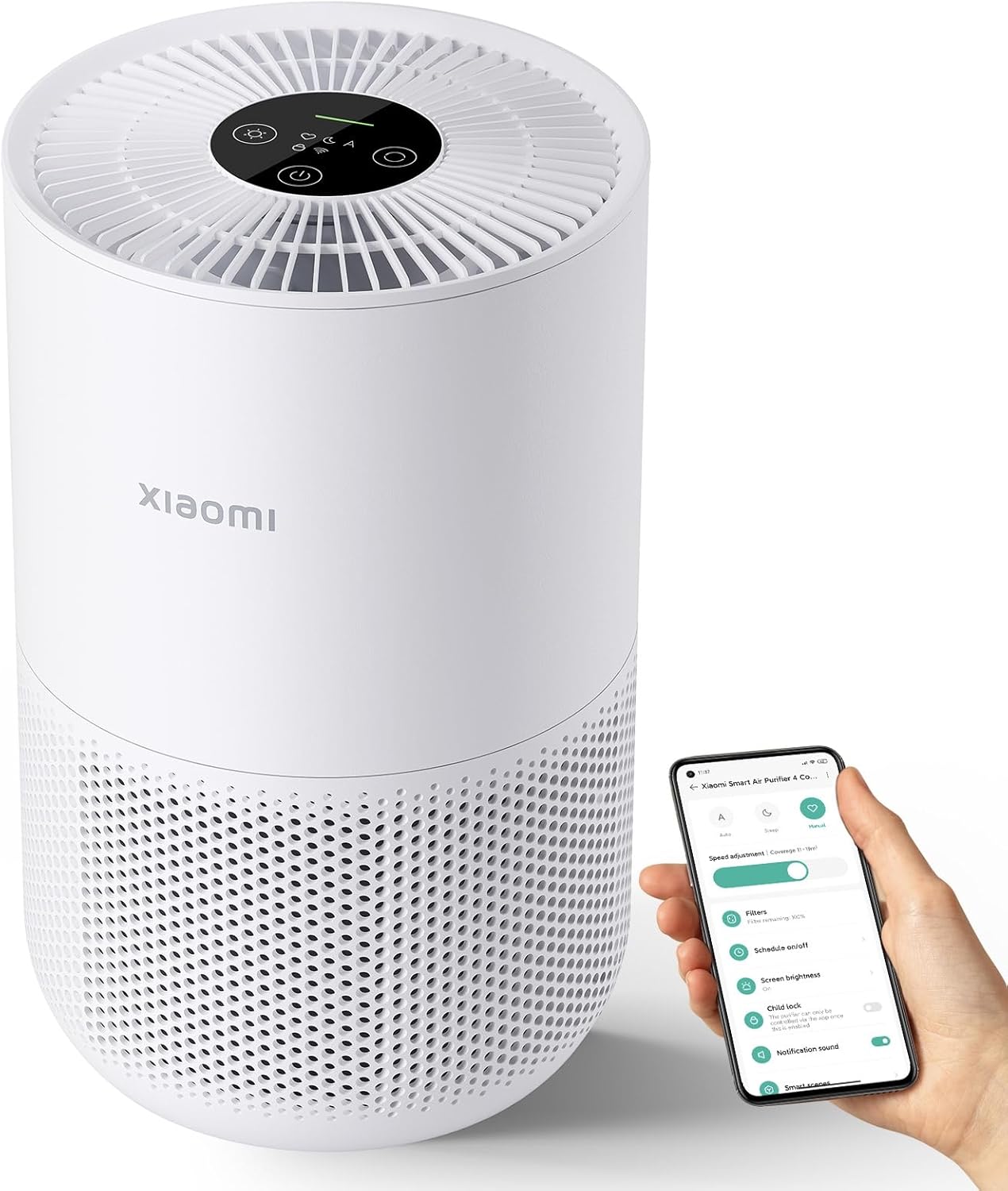
The Air Purifier 4 continues Xiaomi’s iconic cylindrical purifier design language — a white minimalist tower with a 360° air intake around the lower third and a top-mounted fan grille that exhausts clean air upward. It’s understated and inoffensive, designed to blend into a room rather than announce itself. At ~240mm in diameter and 520mm tall, it occupies roughly the same floor footprint as a small side table.
The OLED display is integrated into the front face, showing real-time PM2.5 concentration, temperature, humidity, Wi-Fi status, and operating mode. The display is touch-sensitive — tap to cycle through information screens or adjust settings without reaching for your phone. It’s bright enough to read from across a room but dims automatically in dark environments, a thoughtful touch mentioned positively by multiple Xiaohongshu reviewers who use the purifier in bedrooms.
Build quality feedback on JD.com is overwhelmingly positive. The body uses matte white ABS plastic that resists yellowing over time (a common complaint with older Xiaomi purifier generations), and the fit and finish is consistent. The magnetic front panel covering the filter compartment clicks into place satisfyingly — no flimsy clips or alignment struggles.
One JD.com reviewer’s first impression captures the general sentiment:
“Unboxing was a breeze. The design is pure Xiaomi — clean, minimalist, and actually looks good in my living room. Setting it up with the Mi Home app took under 2 minutes. The OLED display is gorgeous and informative. Already seeing PM2.5 drop after 30 minutes of operation.”
Filtration Performance
The Triple-Layer System
The Air Purifier 4 uses a three-stage filtration approach:
-
Pre-filter (washable mesh): Captures large particles — pet hair, dust bunnies, lint. This extends the life of the HEPA layer.
-
True HEPA H13 filter: The workhorse. Captures 99.97% of particles down to 0.3 microns, including PM2.5, pollen, mold spores, bacteria, and fine dust. H13 is the standard medical/residential grade — it’s what you’ll find in hospital air purification systems.
-
Activated carbon layer: Absorbs VOCs (volatile organic compounds), odors from cooking, smoke, pet smells, and off-gassing from furniture and paint. It’s not a dedicated formaldehyde filter (Xiaomi sells a separate formaldehyde-enhanced filter for ~$10 extra), but it handles everyday household odors effectively.
Real-World CADR Performance
The headline 400 m³/h CADR means the Air Purifier 4 can clean the air in a 28 m² (300 sq ft) room five times per hour — the industry recommendation for allergy and asthma management. For a larger 48 m² (516 sq ft) space, it achieves approximately three air changes per hour, which is adequate for general air quality maintenance.
Chinese user tests confirm the CADR is genuine. A Zhihu reviewer who ran controlled tests with a third-party PM2.5 meter reported:
“Lit a cigarette in a sealed 25sqm room. PM2.5 spiked to 350 μg/m³. Turned on the Air Purifier 4 at max speed. PM2.5 dropped below 35 μg/m³ (China’s ‘excellent’ air quality threshold) in 12 minutes. Below 10 μg/m³ in 22 minutes. The CADR 400 claim checks out.”
Multiple JD.com reviewers in northern Chinese cities (where winter heating season brings significant particulate pollution) report that running the purifier in auto mode keeps indoor PM2.5 consistently below 15 μg/m³ even when outdoor levels exceed 150 μg/m³.
The auto mode uses the built-in laser PM2.5 sensor to adjust fan speed dynamically. When the sensor detects clean air, the fan drops to its lowest setting (near-silent). When PM2.5 spikes — typically from cooking, opening a window, or someone smoking nearby — the fan ramps up automatically to clear the pollution. Users across all platforms praise the auto mode’s responsiveness, though Zhihu reviewers note it’s slightly conservative, sometimes keeping fan speeds higher than necessary for a few extra minutes after the air has cleared.
The OLED Display & Smart Features
Display
The OLED display is a meaningful upgrade over the LED indicator lights on previous Xiaomi purifier generations. It shows:
- Real-time PM2.5 concentration (μg/m³)
- Temperature (°C)
- Humidity (%)
- Wi-Fi connection status
- Current operating mode (Auto, Sleep, Manual, Favorite)
- Filter remaining life
- A color-coded air quality ring (green = good, orange = moderate, red = poor)
The touch interface is responsive, and the auto-dimming feature makes it bedroom-friendly. Xiaohongshu users frequently photograph the display in their home setups — the crisp white text against the dark display surface makes for a surprisingly photogenic appliance.
Mi Home App Integration
As part of Xiaomi’s smart home ecosystem, the Air Purifier 4 connects to the Mi Home app via Wi-Fi (2.4 GHz). The app provides:
- Real-time and historical air quality data with graphs
- Remote control of all purifier settings
- Scheduling (set different modes for different times of day)
- Automation triggers (e.g., “when PM2.5 > 50, set fan to max”)
- Scene integration (e.g., “goodnight scene” = lights off + purifier to sleep mode)
- Voice control via XiaoAI, Alexa, or Google Assistant
- Filter replacement reminders
The app experience is polished and stable — Xiaomi has been refining Mi Home for years, and it shows. The air quality history graphs are genuinely useful for understanding patterns: you can see when cooking dinner causes a PM2.5 spike, how quickly the purifier clears it, and whether your home has a baseline pollution problem you weren’t aware of.
One Xiaohongshu smart-home enthusiast wrote:
“Connected the purifier to my Mi Home ecosystem — when my Aqara window sensor detects an open window, the purifier automatically kicks into high gear. When I leave home (detected by my Xiaomi door lock), it switches to auto mode. The automation possibilities are endless.”
Noise Levels
Noise is a critical factor for any appliance that runs 24/7, and the Air Purifier 4 performs well here. The measured range of 30–65 dB(A) breaks down as follows:
- Sleep mode (~30 dB): Effectively silent. You won’t hear it from more than 1 meter away. Multiple JD reviewers confirm it doesn’t disturb sleep, even for light sleepers.
- Auto mode at low load (~35–40 dB): A gentle white noise — comparable to a quiet ceiling fan. Pleasant rather than intrusive.
- Medium speed (~45–50 dB): Noticeable but not disruptive. Similar to normal conversation level. Fine for daytime use.
- Max speed (~65 dB): Loud. Equivalent to a vacuum cleaner at distance. Appropriate for rapid air cleaning but not for sustained use in occupied rooms.
The consensus from Chinese users: the Air Purifier 4 is quiet enough to sleep next to. Several Xiaohongshu nursery-setup posts feature the purifier as a recommended addition precisely because “开了跟没开一样安静” (it’s so quiet you can’t tell it’s on).
Filter Maintenance & Cost of Ownership
The long-term cost of any air purifier is defined by filter replacements, not the upfront price — and this is where Xiaomi’s value proposition becomes particularly compelling.
The standard replacement filter (pre-filter + HEPA H13 + activated carbon) costs ~$25–35 and lasts 6–12 months depending on usage intensity and air quality. In a typical Chinese urban environment with moderate pollution, most users report replacing every 8–10 months.
Compare this to Dyson’s combined HEPA + carbon filter at $79–99, or Blueair’s at $60–90, and the five-year cost differential becomes significant:
| Brand | Upfront Cost | Filter Cost (per replacement) | Filters Over 5 Years | 5-Year Total |
|---|---|---|---|---|
| Xiaomi | $149–199 | $25–35 | ~6 replacements | $299–409 |
| Dyson | $569–749 | $79–99 | ~5 replacements | $964–1,244 |
| Blueair | $409–629 | $60–90 | ~5 replacements | $709–1,079 |
Over five years, the Xiaomi costs roughly one-third of an equivalent Dyson and half of a Blueair. That’s real money — and the air quality delivered is objectively similar across all three brands for particulate filtration.
The filter replacement process is tool-free: the magnetic front panel pops off, the old filter slides out, the new one slides in, and the panel snaps back. The Mi Home app tracks filter life and sends a notification when replacement is due.
What Chinese Users Are Saying
From JD.com — 5-star (Beijing resident): “Living in Beijing, an air purifier is essential during winter. Bought the Xiaomi 4 to replace my aging Philips. The PM2.5 sensor is accurate (verified against a separate monitor), the auto mode is responsive, and the OLED display is beautiful. Best value purifier on the market.”
From SMZDM — 5-star (comparison with Dyson): “Had a Dyson TP04 for two years. Bought the Xiaomi 4 for the bedroom. Honestly, the Xiaomi cleans air just as effectively. The Dyson has more sensors and the fan/heater combo is nice, but for pure air purification at one-third the price, the Xiaomi is the obvious choice.”
From Xiaohongshu — 5-star (pet owner): “Two cats, one Samoyed. The fur situation is real. This purifier has noticeably reduced the ‘dog smell’ in my apartment and the floating fur is way down. The pre-filter catches most of the visible fur — I clean it every 2 weeks. Filter replacement at 8 months. Worth every yuan.”
From JD.com — 4-star (filter availability): “The purifier itself is excellent. Only complaint: the replacement filters were out of stock for about 3 weeks when I needed one. Ended up buying from a third-party seller at a markup. Xiaomi should keep filters consistently in stock for a product this popular.”
From Zhihu — 4-star (tech analysis): “Objectively: CADR 400 is real. H13 HEPA is genuine. The PM2.5 sensor correlates well with reference instruments (±5 μg/m³ at low concentrations). The activated carbon layer is the weakest link — it’s more of an odor absorber than a VOC destroyer. For dedicated formaldehyde/benzene removal, get the enhanced filter or a specialized unit.”
Xiaomi Air Purifier 4 vs. Competition
Xiaomi Smart Air Purifier 4 vs. Dyson Purifier Hot+Cool
Dyson brings the bladeless fan/heater combo, more comprehensive sensors (VOC, NO2, PM10), and that unmistakable industrial design. It’s a more versatile appliance — an air purifier, fan, and space heater in one. But for pure air purification, it’s overpriced at 3–4× the Xiaomi’s cost.
Choose Dyson if: You want a single device that purifies, cools, and heats, and you’re willing to pay a significant premium for the ecosystem and design.
Choose Xiaomi if: You want clean air at a reasonable price and don’t need built-in heating/cooling.
Xiaomi Smart Air Purifier 4 vs. Blueair Blue Pure 211+
Blueair is the Scandinavian premium option — excellent filtration, good design, strong brand reputation. The Blue Pure 211+ offers higher CADR (~590 m³/h) for larger spaces at $300–350. The Xiaomi counters with the OLED display, smart home integration, and dramatically lower filter costs.
Choose Blueair if: You need very high CADR for a large open-plan space and prefer a premium brand with a long track record.
Choose Xiaomi if: Your space is under 50 m² (540 sq ft), you value smart features and app control, and you want to minimize total cost of ownership.
Xiaomi Smart Air Purifier 4 vs. Xiaomi Smart Air Purifier 4 Pro
The Pro variant bumps CADR to 500 m³/h, adds an ionizer (defeatable), and has a larger coverage area (35–60 m²). It costs ~$50–80 more. For most apartments under 50 m², the standard 4 is sufficient. If you have an open-plan living area above 50 m², the Pro’s extra capacity is worthwhile.
Pros & Cons
✅ Pros
- Excellent value — CADR 400 with HEPA H13 for $149–199
- Genuine filtration performance — verified PM2.5 reduction in controlled tests
- OLED touch display — real-time air quality data at a glance
- Responsive auto mode — adjusts fan speed based on PM2.5 readings
- Full Mi Home integration — scheduling, automation, remote control, voice commands
- Quiet operation — 30 dB in sleep mode, suitable for bedrooms and nurseries
- Low filter costs — $25–35 per replacement, one-third of Dyson
- Clean, minimalist design — fits any room aesthetic
- Tool-free filter changes — magnetic panel, slide-out cartridge
❌ Cons
- Basic carbon filter — odor absorption, not true VOC destruction
- No heating/cooling — air purification only (Dyson offers multi-function)
- Fewer sensors than premium competitors — no VOC, NO2, or PM10 sensors
- 2.4 GHz Wi-Fi only — no 5 GHz support
- Replacement filter stock issues — occasional out-of-stock periods reported
- Not ideal for very large open spaces — above 50 m², consider the Pro model
Frequently Asked Questions
What room size is the Air Purifier 4 suitable for?
Xiaomi rates it for 28–48 m² (300–516 sq ft). In a 28 m² room, it achieves 5 air changes per hour — ideal for allergy sufferers. In a 48 m² room, roughly 3 air changes per hour — adequate for general air quality. For open-plan spaces above 50 m², consider the Air Purifier 4 Pro (CADR 500).
Does it remove cooking smells and smoke?
The activated carbon layer absorbs cooking odors, smoke, and pet smells effectively. It’s not a heavy-duty smoke eater — for chain smokers or serious kitchen exhaust issues, a dedicated smoke removal unit may be necessary — but for everyday cooking smells and occasional smoke, it performs well.
Is the filter washable?
The pre-filter (outer mesh) is washable — rinse with water and dry completely before reinstalling. The HEPA and activated carbon layers are NOT washable — replacing them is the only option once they’re saturated. Washing a HEPA filter destroys its electrostatic charge and renders it ineffective.
Does it work with Apple HomeKit?
Not natively. The Air Purifier 4 integrates with Xiaomi’s Mi Home ecosystem, Alexa, and Google Assistant. For HomeKit compatibility, you’d need a Homebridge or Home Assistant bridge running the Mi Home plugin. This is a common workaround, and it works reliably, but it’s not an official feature.
How accurate is the built-in PM2.5 sensor?
The laser PM2.5 sensor is calibrated at the factory and correlates well with reference instruments (±5 μg/m³ at concentrations below 100 μg/m³). It’s accurate enough for auto mode adjustments and trend monitoring. For scientific-grade measurements, use a dedicated monitor, but for everyday use, the built-in sensor is more than sufficient.
Can I run it 24/7?
Yes — and most users do. The Air Purifier 4 is designed for continuous operation. In auto mode, it spends most of its time at low/silent speeds, only ramping up when pollution is detected. Power consumption at low speed is ~5–8W — roughly $5–10 per year in electricity costs for 24/7 operation.
Does the Xiaomi Air Purifier 4 produce ozone?
No. Unlike some older air purifiers that use ionizers or UV-C lamps, the Air Purifier 4 is a purely mechanical filtration device (fan + filters). It doesn’t produce ozone or any other byproducts. The Air Purifier 4 Pro includes a user-defeatable ionizer; the standard 4 does not.
Final Verdict
Rating: 9.0 / 10 ⭐
The Xiaomi Smart Air Purifier 4 does exactly what it promises — deliver clean air, intelligently and quietly, at a price that makes premium brands blush. The CADR 400 rating is honest, the HEPA H13 filtration is genuine, the OLED display is informative, and the Mi Home integration opens up a world of automation possibilities.
It’s not the most feature-rich purifier on the market. It doesn’t heat or cool (Dyson), it doesn’t have the highest CADR in its class (Blueair), and its carbon filter is more odor-absorber than VOC-destroyer. But for $149–199 with $25–35 replacement filters, it doesn’t need to be any of those things. It needs to deliver clean air affordably — and it does.
If you’re looking for an air purifier that gets the fundamentals right without the luxury tax, the Xiaomi Smart Air Purifier 4 is the best value in its class. Your lungs and your wallet will both thank you.
Who should buy:
- Apartment dwellers and homeowners with rooms up to 50 m²
- Allergy and asthma sufferers who need reliable HEPA filtration
- Pet owners dealing with dander and odor
- Anyone building a Xiaomi/Mi Home smart ecosystem
- Value-conscious buyers who want premium features at budget prices
Who should skip:
- Large open-plan homeowners (get the Pro model or a Blueair 211+)
- Those who want a purifier + fan + heater combo (Dyson is the only real option)
- VOC-sensitive users with new furniture/renovations (get the formaldehyde-enhanced filter)
- Apple HomeKit purists who need native integration
Prices and availability accurate as of May 2026. Conversion rates approximate (1 USD ≈ 7.2 CNY). Reviewed model: Xiaomi Smart Air Purifier 4 (AC-M16-SC).
Not sure which to choose?
Compare specs side-by-side with our Product Comparator Tool
Related Reviews
TP-Link Tapo Camera Review: Budget Security Done Right, Trusted by Millions
In the world of smart home security cameras, the TP-Link Tapo series is a near-dominant force. The single C200 model has
Yeelight Smart Light Review: Affordable Smart Lighting, the Mi Ecosystem's Best Value
If your smart home journey starts with a single light — Yeelight is probably the best choice you can make.
Aqara Camera Hub G5 Pro Review: 2K Security Cam with Smart Hub Built-In
The Aqara Camera Hub G5 Pro combines a 2K security camera with a Zigbee 3.0 hub in one device, offering local AI detecti

Aqara Smart Curtain Motor Review: The $99 Motor That Makes Any Curtain Smart
Aqara's smart curtain motor is one of the best-selling smart home automation products on Chinese e-commerce, bringing vo
Aqara Door and Window Sensor T1 Review: Know When Things Open and Close
Aqara Door/Window Sensor T1 delivers reliable open/close detection with 2-year battery life at ¥69 — an essential buildi