Xiaomi Smart Air Purifier 4 Lite Review: 500K+ JD Buyers Can't Be Wrong at ¥520
The Xiaomi Mijia Air Purifier 4 Lite packs HEPA filtration, Mi Home smart connectivity, and whisper-quiet operation into a ¥520–704 price point, backed by 500,000+ JD reviews with a 98% positive rate — but its limited CADR, sensor accuracy quirks, and mixed noise reviews remind you this is the budget champion, not the performance king.
Introduction
Can a ¥520 (~$73 USD) air purifier actually clean your air — or is it just a fan in a white box? With 500,000+ verified buyers on JD.com, a 98% positive rating, and the #1 spot on JD’s Air Purifier Bestseller Chart, the Xiaomi Mijia Air Purifier 4 Lite (米家空气净化器4 Lite, model AC-M17-SC) has become the default choice for millions of Chinese households looking to tackle PM2.5, formaldehyde, pet dander, and cooking odors without breaking the bank.
Across JD.com’s official Xiaomi stores, the 4 Lite has accumulated over 90万 units sold (900,000+) on a single listing alone. On Xiaohongshu (小红书), over 1,000 user-generated notes debate its merits — from allergy relief and cat hair collection to DIY formaldehyde-hacking modifications. But behind the 98% aggregate score lurk genuine complaints: sensor accuracy quirks, mixed noise levels for sensitive sleepers, and the inherent limitations of a budget filter.
This is the full picture of Xiaomi’s budget air purifier champion — what it does brilliantly, where it cuts corners, and whether ¥520 is the best money you’ll ever spend on your lungs.
Specifications
| Feature | Xiaomi 4 Lite (AC-M17-SC) | Mijia 4 Pro (AC-M15-SC) | Philips 2000i | Dyson Purifier Cool TP07 | Levoit Core 300S |
|---|---|---|---|---|---|
| Price (JD) | ¥520–704 (~$73–99) | ¥1,069–1,199 (~$150–168) | ¥2,499–2,999 (~$350–420) | ¥3,499–3,999 (~$490–560) | ¥699–899 (~$98–126) |
| CADR (Particulate) | ~310 m³/h | ~500 m³/h | 380 m³/h | ~290 m³/h (est.) | 240 m³/h |
| CADR (Formaldehyde) | ~120 m³/h | ~220 m³/h | 200 m³/h | ~50 m³/h (est.) | ~90 m³/h |
| Applicable Area | 22–38 m² | 35–60 m² | 27–46 m² | 25–35 m² | 20–30 m² |
| Noise Level | 33–62 dB(A) | 34–65 dB(A) | 34–64 dB(A) | 33–63 dB(A) | 22–52 dB(A) |
| Filter Type | 3-in-1 composite (pre-filter + HEPA H12 + activated carbon) | 3-in-1 with negative ion | HEPA + activated carbon | HEPA H13 + activated carbon | HEPA + activated carbon |
| Modes | 3 (Auto, Sleep, Favorite) | 4 (Auto, Sleep, 1-3 manual) | 4 (Auto, Sleep, Turbo, Manual) | 10 speed settings | 4 (Auto, Sleep, Manual, Turbo) |
| Smart Features | Mi Home App, XiaoAi voice | Mi Home App, XiaoAi, LED display | Philips Air+ App | MyDyson App | VeSync App, Alexa |
| Sensor | PM2.5 laser sensor | PM2.5 + formaldehyde sensor | PM2.5 + gas sensor | PM2.5 + VOC + temp/humidity | PM2.5 laser sensor |
| Dimensions | 240 × 240 × 533 mm | 260 × 260 × 738 mm | 250 × 250 × 585 mm | 220 × 220 × 1050 mm | 220 × 220 × 360 mm |
| Net Weight | ~4.8 kg | ~7.5 kg | ~4.9 kg | ~5.3 kg | ~4.2 kg |
| Rated Power | 28W | 50W | 56W | 40W | 26W |
| Energy Rating | Level 1 | Level 1 | Level 2 | — | Level 1 |
Note: Xiaomi CADR values are manufacturer-specified and not independently verified. Some CADR values for competitors are estimates based on available public data.
Design and Build Quality
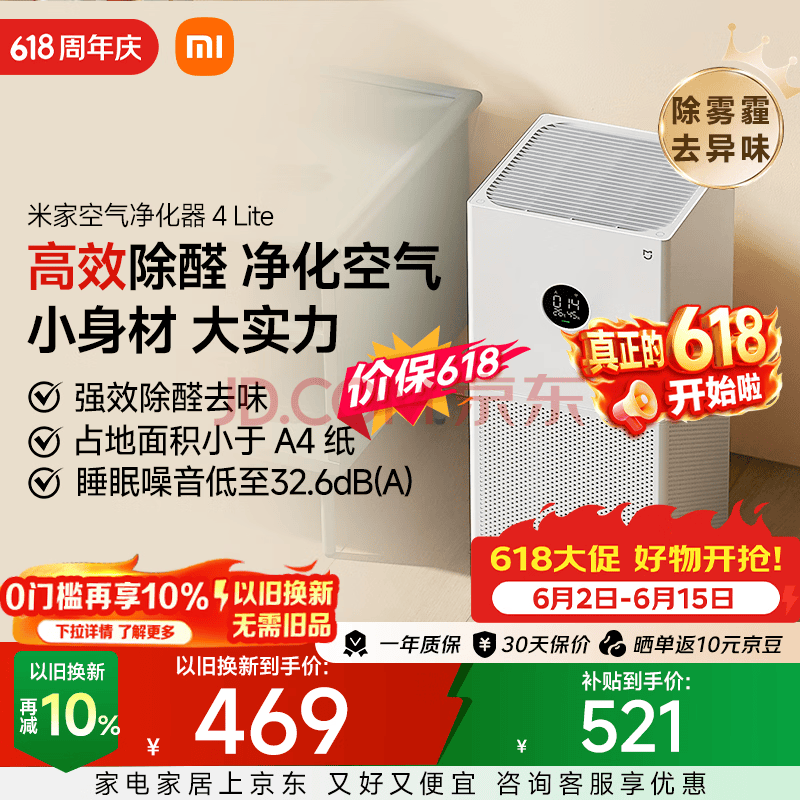
The 4 Lite follows Xiaomi’s signature design language: a minimalist white cylinder with rounded edges, a small circular LED display on the front, and a single physical button on top. At 240 × 240 × 533 mm, it occupies about as much floor space as a dining plate — intentional for a device that lives in bedrooms and small apartments.
Air intake runs through a 360° perforated lower shell, with clean air exhausted upward through the top grille. The filter compartment opens from the bottom with a twist-lock mechanism that’s genuinely simple — no tools, no wrestling. This matters because you’ll be doing it every 6–12 months.
However, build isn’t flawless. Multiple XHS users report that the bottom cover’s intake holes are small enough to trap cat hair (捶你猪头, 406 likes, 2025-04-30). The plastic filter compartment locking mechanism can feel slightly loose after repeated filter changes, though this doesn’t affect sealing or performance.
Purification & Performance
Core Filtration
The 4 Lite uses a cylindrical 3-in-1 composite filter: a nylon pre-filter captures large particles (dust, pet hair), an H12-grade HEPA layer traps PM2.5 down to 0.3 microns, and an activated carbon layer adsorbs formaldehyde, VOCs, and odors. It’s the standard budget air purifier architecture — effective within its CADR limits, unremarkable in design.
At a ~310 m³/h particulate CADR, the 4 Lite can clean the air in a 25 m² bedroom approximately 4–5 times per hour (assuming standard 2.5m ceiling height). That’s firmly in the “small room” category. For a 15–20 m² bedroom, it’s perfectly adequate. For a 40 m² living room, you’re asking too much.
Formaldehyde CADR is approximately 120 m³/h — helpful but not a substitute for ventilation. As XHS user Eline的家 (2,516 likes, 2025-03-01) put it: “The best method for removing formaldehyde is ventilation. This is a cost-effective lazy-person method.” She paired her 4 Lite with DIY potassium permanganate balls for enhanced formaldehyde capture — creative, but telling.
Real-World Purification
Across JD.com’s review ecosystem, “净化效果很好” (purification works great) is the #1 most-mentioned tag at 1,790 mentions. “净化超快” (purifies very fast) comes in at 3rd place with 366 mentions. Users consistently report reduced dust accumulation, faster odor dissipation, and subjectively “fresher” air.
JD reviewer 佳平7028 (verified purchase, 5 stars) reports: “At this price, the value is incredible. Low noise on startup, purification is fast, room odors dissipate quickly. Easy to operate, compact, filter replacement is simple — more than adequate for daily home use.”
XHS user 小米粥 (435 likes, 2024-07-29) bought the 4 Lite for her pharyngitis and her child’s allergic rhinitis: “I put it in the bedroom. Sleep mode doesn’t affect sleep at all. Even with southern humidity at 65–80%, the filter hasn’t developed any smell. The odor removal is genuinely impressive — it even handles kitchen oil smoke drifting upstairs. I recommend it to everyone who needs an air purifier.”
For everyday particulates and household odors, the 4 Lite punches above its price. But the budget filter has its ceiling.
Noise & Sleep Performance
This is the most divisive aspect of the 4 Lite, and the data tells a clear story.
On JD.com, “静音效果佳” (excellent quietness) received 216 mentions — good but not dominant, ranking #4 behind purification-related tags. JD reviewer 海***0 calls it “基本没有噪音” (basically no noise). But XHS user Sam暖阳 (7 likes, 2024-11-29) tells a different story: “The Mijia 4 Lite is so loud it keeps me awake, even in sleep mode. I measured 40dB at the outlet and 33dB at the side. My old 2S measured about 10dB next to the unit. For someone noise-sensitive like me, the difference is huge.”
The gap between these experiences is explainable: the 4 Lite in sleep mode runs at approximately 33 dB(A) — whisper-quiet on paper, but the actual perceived noise depends heavily on distance, room acoustics, and individual sensitivity. The fan in a cylindrical design like this creates a specific frequency profile that some ears find more intrusive than the decibel number suggests.
XHS user Momo (299 likes, 2025-12-11), who compared the 4 Lite against the Xiaomi 5, provides the most actionable insight: “In sleep mode, the 4 Lite is quiet, but purification power drops noticeably if you leave a window cracked. On auto/favorite mode, the noise is obvious and affects sleep.” Her conclusion: 4 Lite is best for closed-window sleeping — the 5’s additional manual speed levels let you balance noise and purification better if you sleep with ventilation.
Smart Features & App Experience
The 4 Lite connects to Xiaomi’s Mi Home ecosystem via 2.4GHz Wi-Fi. Through the Mi Home app (iOS/Android), you get:
- Real-time PM2.5 readings — displayed on both the device’s LED screen and the app
- Remote control — power on/off, mode switching, manual fan speed
- Automation — link to other Mi Home devices (e.g., turn on when you leave home, off when you arrive)
- Filter life tracking — percentage-based with push reminders
- Scheduling — set on/off times by day and hour
- Voice control — XiaoAi speaker integration (“小爱同学, 打开空气净化器”)
“操作超简洁” (super simple operation) is the #2 review tag on JD at 1,057 mentions. JD verified buyer 海***0 confirms: “You can control it from your phone and connect it to XiaoAi speaker.” XHS user Momo mentions connecting to Xiaomi’s smart home ecosystem for automated scenarios.
The LED display shows a colored ring (green/yellow/red) corresponding to air quality, along with a numeric PM2.5 reading. “触屏超灵敏” (touch screen very sensitive) received 14 tag mentions — the display is responsive, though not as feature-rich as the OLED on the 4 Pro.
One notable absence: there’s no formaldehyde sensor. The PM2.5 laser sensor handles particulates only, so formaldehyde removal operates on faith unless you have an external monitor.
What Chinese Users Say
Aggregated Ratings: 98% positive rate (500,000+ reviews on JD.com) | 1,000+ notes on Xiaohongshu
JD.com User Reviews
“Buying the Xiaomi Purifier 4 Lite was so worth it! Stable operation, gentle airflow, indoor odors dissipate quickly. The minimalist body matches any décor. Smart connectivity is very convenient, silence is excellent — perfectly suitable for daily home and bedroom use.” — 美食家北京, JD.com verified purchase (featured review)
“Design is very clean, the white shell looks pristine. Purification: works great, very comfortable experience. Noise: basically no noise, strong airflow, good results. Installation: easy to assemble, tiny footprint. For a small room, the 4 Lite is more than enough. Multiple modes to choose from, can control from phone, connects to XiaoAi speaker.” — 海***0, JD.com verified purchase (featured review)
“This Xiaomi Purifier 4 Lite has incredible value. Low noise on startup, purifies quickly, room odors vanish fast. Simple operation, compact size doesn’t take space, filter replacement is easy. More than adequate for daily home use.” — 佳平7028, JD.com verified purchase (featured review)
Xiaohongshu User Reviews
“Bedroom Air Purifier Comparison — 4 Lite vs Mi 5: As someone who can’t live without ventilation in Sichuan — Chengdu’s winter smog is unbearable. I have a sensitive respiratory system and can’t fully close windows to sleep, so I rely entirely on air purifiers. I bought the 4 Lite years ago blind; not a data person, purely judge by how my throat and nose feel, and it genuinely works. This year I gave the old one to family and bought the Mi 5 for my larger bedroom. Noise & Modes: 4 Lite has only 3 modes — auto, sleep, favorite. With windows cracked and smog (150+ outside), auto/favorite modes are noticeably noisy and affect sleep. Sleep mode is quiet but purification drops — essentially useless with the window open. The Mi 5 adds manual speeds 1/2/3, letting you balance noise and purification. Verdict: If you sleep with windows fully closed, the 4 Lite is exceptional value and the filter is incredibly durable. If you need ventilation during sleep, the 5’s low-noise efficiency is worth the ¥200 premium.” — 小红书用户@Momo (299 likes, Dec 11, 2025)
“My Thoughts After Using the Xiaomi Purifier: I bought it June 25th and use it daily unless nobody’s home. I have pharyngitis and my baby has allergic rhinitis + cough, especially during seasonal transitions. I did a lot of research — air purifiers can absorb dust, deodorize, and remove oil smoke, but prices vary wildly. I decided after visiting a friend who has the 4 Pro for her large living room. I chose the 4 Lite for its value and solid adsorption. It has three modes: standard, sleep, and a customizable favorite. I use standard during the day and sleep at night. Sleep mode doesn’t disturb sleep. Even with southern humidity at 65–80%, no filter smell so far. Odor removal is genuinely impressive — it even removes kitchen oil smoke that drifts upstairs. I genuinely feel the air is better. It can deodorize and remove sweat smell. When I don’t want to open windows, I just turn on the purifier. It’s worth every yuan.” — 小红书用户@小米粥 (435 likes, Jul 29, 2024)
“Xiaomi Air Purifier 4 Lite Usage Experience: I’ve had it for a while now, and it’s really good. My bedroom can’t open windows, so nights felt stuffy — hence the purchase. The air genuinely feels fresher after running it. Tried it in a fully sealed room with door and windows closed — that doesn’t work, still feels stuffy. But with the door open and windows closed, it’s just right. If you have a fresh air system, you can go fully sealed. For the price, if you can’t open windows for some reason, the 4 Lite with the door open genuinely improves quality of life — especially since you spend half your day (sleeping + scrolling) in the bedroom.” — 小红书用户@Bonjour (215 likes, Mar 28, 2025)
“This Thing Has No Suction At All! 🆘: Turned it to max fan speed and still barely feel any suction around the filter. If it can’t pull dust toward it, how does it purify? Can someone who understands the principle explain? 🙏” — 小红书用户@小红薯6696246F (25 likes, Jul 18, 2024)
“Way Too Loud — Mijia Air Purifier: The 4 Lite is so loud it’s keeping me up at night, even in sleep mode. Tested with my phone’s noise meter: 40dB at the outlet (probably due to strong airflow), 33dB at the upper side, about 20dB beside the unit. My old 2S stays around 10dB beside the unit. For someone noise-sensitive like me, the difference is massive. Is it just my unit, or are all 4 Lites like this?” — 小红书用户@Sam暖阳 (7 likes, Nov 29, 2024)
“My Air Purifier Shows 95 While Official Data Shows 42: I got back to my dorm today, closed the window, turned on the purifier — PM2.5 showed 108, dropped to 90-something after a few minutes. Checked official data for comparison — only 42. Device is Xiaomi 4 Lite. Official data from Caiyun app. November 14, 2024, around 9:15pm.” — 小红书用户@2020 (15 likes, Nov 14, 2024)
Review Theme Summary
| Theme | Sentiment | Key Detail |
|---|---|---|
| Value for Money | ⭐⭐⭐⭐⭐ | Nearly universal praise — “can’t complain at this price” is the dominant refrain across both JD and XHS |
| Purification (Odor/PM2.5) | ⭐⭐⭐⭐ | Effective for bedrooms and small rooms; handles typical household odors, cooking smells, and seasonal smog |
| Noise (Sleep Mode) | ⭐⭐⭐ | Divisive — rated “excellent quietness” by many JD buyers, but noise-sensitive users on XHS report dissatisfaction at 33–40dB |
| Smart Features | ⭐⭐⭐⭐⭐ | Mi Home app + XiaoAi voice control is genuinely polished and adds real convenience |
| Sensor Accuracy | ⭐⭐⭐ | PM2.5 sensor reports higher readings than external references per XHS user reports |
| Build Quality | ⭐⭐⭐⭐ | Solid for the price; minor gripes about small intake holes trapping pet hair |
| Filter Durability | ⭐⭐⭐⭐⭐ | Multiple users report filters lasting well over a year without odor or performance drop |
| Suction/Power | ⭐⭐⭐ | Designed for room circulation, not targeted suction — confuses some first-time buyers expecting vacuum-like intake |
Pros & Cons
Pros:
- Exceptional value at ¥520–704 (~$73–99 USD) — the cheapest quality air purifier from a major brand
- Real purification you can feel — users consistently report fresher air, reduced dust, and better breathing
- Compact footprint (240×240mm) fits in any bedroom
- Mi Home app integration and XiaoAi voice control are genuinely polished
- Filter is exceptionally durable — XHS users report 1+ years without replacement or odor
- 98% positive rate from 500K+ JD reviews — statistically one of the best-reviewed products in its category
- Energy-efficient Level 1 rating, 28W consumption
- Easy bottom-access filter replacement with tool-free twist-lock
Cons:
- Limited CADR (~310 m³/h) — unsuitable for spaces over 30 m²
- Sleep mode noise is subjective — noise-sensitive users may find even 33dB intrusive depending on room acoustics
- No formaldehyde sensor — formaldehyde removal operates on trust
- PM2.5 sensor tends to read high compared to external references (reported 2–3x discrepancy)
- 3 modes limit fine-tuning compared to competitor models with manual speed levels
- Intake holes are small — pet hair can clog the outer grille (XHS users report DIY modifications)
- Not designed for open-window purification — CADR drops off sharply with ventilation
- 360° intake means you can’t place it flush against a wall
vs Competitors
vs Philips 2000i (¥2,499–2,999): The Philips has higher CADR (380 m³/h particulate, 200 m³/h formaldehyde), a more sophisticated sensor array (PM2.5 + gas), and a premium filter that captures 99.97% of particles down to 0.003 microns. But at 4–5× the price, the Philips is a different category. Choose the Philips if you have severe allergies, asthma, or live in a heavily polluted area. Choose the 4 Lite if you want 80% of the experience at 20% of the cost.
vs Dyson Purifier Cool TP07 (¥3,499–3,999): The Dyson doubles as a fan, has superior VOC/NO₂ sensing, and is better designed as furniture. But its formaldehyde CADR is notably weak (~50 m³/h), and the price is absurd for what you get. The 4 Lite outperforms the Dyson on formaldehyde at a fraction of the cost. Buy Dyson for the design statement; buy Xiaomi for air purification.
vs Levoit Core 300S (¥699–899): The closest budget competitor. Levoit offers quieter operation (22–52 dB), Alexa integration, and a slightly more compact form factor (360mm height). But CADR is lower at 240 m³/h, and the JD review volume and ecosystem integration are dwarfs compared to Xiaomi’s. The 4 Lite wins on value, CADR, and smart home ecosystem.
vs Mijia Air Purifier 4 Pro (¥1,069–1,199): The Pro upgrade adds a formaldehyde sensor, negative ion generator, higher CADR (500 m³/h), OLED display, and manual speed levels. It’s objectively better — but ¥500–700 more. If your room exceeds 30 m² or you prioritize precise formaldehyde monitoring, the Pro is worth the upgrade. For a typical 15–20 m² bedroom, the 4 Lite does the job for half the price.
vs Huawei Smart Choice 720 3i (¥499–652): Huawei’s budget purifier supports their smart ecosystem and is priced similarly. CADR and filtration are comparable, but the 4 Lite has the massive advantage of Xiaomi’s broader smart home network and XiaoAi integration. Buy the Huawei only if you’re already deep in the Huawei ecosystem.
Who Should Buy
✅ Budget-conscious first-time buyers — At ¥520 (with government subsidy), this is the lowest-risk entry point into air purification from a trusted brand. 500K+ buyers can’t all be wrong.
✅ Bedroom users (15–25 m²) — The 4 Lite is optimized for bedroom dimensions. CADR is adequate, sleep mode works for most people, and the compact footprint fits anywhere.
✅ Allergy and respiratory sensitivity users — XHS reviews specifically cite improvement for pharyngitis, allergic rhinitis, seasonal allergies, and smog sensitivity. It’s not medical-grade, but users feel the difference.
✅ Xiaomi/Mi Home ecosystem users — If you already own Xiaomi smart home products, the 4 Lite slides in seamlessly with XiaoAi voice control and automation scenes.
✅ Pet owners (with caveats) — JD Q&A confirms it captures pet hair and dander. Multiple XHS users bought it specifically for cats. Just be prepared to clean the intake grille.
✅ Renters and dorm residents — The small footprint, easy setup, and low price make this ideal for rental situations where you can’t install a fresh air system.
Who Should Skip
❌ Large room / open-plan users — If your room exceeds 30 m², the 4 Lite will run at max speed constantly and still under-clean the air. Get the 4 Pro or 4 Max instead.
❌ Extremely noise-sensitive sleepers — If you’re the type who can hear a laptop fan from across the room, the 4 Lite’s sleep mode at ~33dB may still bother you. XHS user Sam暖阳’s experience is valid. Consider the Levoit Core 300S which goes down to 22dB.
❌ Severe allergy/asthma sufferers needing medical-grade filtration — H12 HEPA is good, but medical-grade air purification requires H13+ and higher CADR. Philips or IQAir are more appropriate for medical needs.
❌ Window-open sleepers — As XHS user Momo’s detailed comparison makes clear, the 4 Lite can’t maintain purification with windows open. This is a closed-environment device.
❌ Those who want precise formaldehyde monitoring — The 4 Lite lacks a formaldehyde sensor. If you’re specifically targeting formaldehyde (new renovation, new furniture), the 4 Pro’s sensor is worth the upgrade.
FAQ
Q: How often should I replace the filter? A: Xiaomi recommends every 6–12 months depending on usage. Multiple XHS users report filters lasting 12+ months without odor or performance degradation. The Mi Home app tracks filter life percentage and sends replacement reminders. Replacement filters cost approximately ¥149–199 on JD.com.
Q: Can it really remove formaldehyde? A: Yes, the activated carbon layer adsorbs formaldehyde, but with a CADR of ~120 m³/h, it’s supplementary — not a primary formaldehyde solution. As XHS user Eline的家 notes, ventilation is still the most effective method. For new renovations with high formaldehyde levels, pair it with ventilation or get a dedicated formaldehyde purifier.
Q: How much electricity does it use? A: Rated at 28W, running 24/7 costs approximately ¥0.34 per day (at ¥0.5/kWh) — about ¥10/month or ¥124/year. XHS user 大米稀饭就咸菜 measured daily power consumption and found it “very acceptable.”
Q: Is it suitable for pet hair and dander? A: Yes — JD Q&A and XHS reviews (捶你猪头, 406 likes) confirm it captures pet hair and dander. However, the intake holes are relatively small, so visible pet hair may collect on the outer grille rather than entering the filter. Regular vacuuming of the intake area is recommended.
Q: Why does my PM2.5 reading seem higher than the weather app? A: This is a known quirk reported by XHS user 2020 — the 4 Lite’s built-in sensor tends to read higher than external references. Possible reasons: the sensor measures local air (immediately around the unit), not regional averages; indoor PM2.5 can genuinely differ from outdoor readings; and the budget sensor may have calibration drift. The number is best used for relative trend tracking (is it improving?) rather than absolute accuracy.
Q: Can I use it without the Mi Home app? A: Yes — basic controls (power, mode cycling) are available via the physical button and LED display on the device itself. But the app is recommended for filter life tracking, scheduling, and automation.
Q: Can I place it against a wall? A: No. The 360° intake design requires clearance on all sides for proper airflow. Xiaomi recommends at least 20cm clearance from walls and furniture.
Rating: 8.2/10
| Category | Score |
|---|---|
| Value | 9.5/10 |
| Purification Performance | 7.5/10 |
| Noise (sleep mode) | 7.5/10 |
| Build Quality | 8/10 |
| Smart Features | 9/10 |
| Sensor Accuracy | 6.5/10 |
| Filter Durability | 9/10 |
| User Satisfaction | 8.5/10 |
Bottom Line: The Xiaomi Mijia Air Purifier 4 Lite is the definitive budget air purifier for Chinese households — and by extension, one of the best-value air purifiers available anywhere. At ¥520–704, backed by 500,000+ reviews and a 98% positive rate, it delivers on its core promise: you will breathe fresher air and notice fewer odors in your bedroom. The noise won’t please everyone, the sensor has its quirks, and you shouldn’t expect it to clean a living room or filter out a construction site next door. But for a 15–25 m² bedroom with the windows closed, it’s genuinely hard to beat at this price. If you’re willing to spend ¥1,200, buy the 4 Pro. If you’re budget-constrained or just want to dip your toes into air purification, the 4 Lite is the smartest ¥500 you’ll spend on your lungs this year.
Not sure which to choose?
Compare specs side-by-side with our Product Comparator Tool
Related Reviews
Best Portable Air Conditioners 2026: Stay Cool Anywhere with Top Chinese Cooling Solutions
The ultimate guide to portable air conditioners and evaporative coolers in 2026 — testing Midea, Gree, Xiaomi, Muji, and
Best Wet-Dry Vacuums 2026: Top 5 Smart Floor Cleaners Compared for Spotless Chinese Homes
The definitive guide to the best wet-dry vacuums (洗地机) in China for 2026 — comparing Tineco, Dreame, Roborock, Narwal, a

Gree Qingfeng Inverter AC Review: 500,000+ JD Reviews on China's #1 Air Conditioner Brand
Gree Qingfeng inverter AC review: new Level 1 energy, variable frequency, WiFi smart control, and 500,000+ real JD & Xia
Xiaomi Robot Vacuum X10+ Review: Full Automation at ¥1,670 — Worth the Trade-Offs?
The Xiaomi Robot Vacuum X10+ (米家全能扫拖机器人 X10+) packs an all-in-one base station with auto mop washing, dust collection, a

Xiaomi Smart Humidifier 2 Review: 4.5L UV-C Sterilization at ¥149 — But Real Users Warn of Mold and Reliability Issues
The Xiaomi Smart Humidifier 2 offers 4.5L capacity, UV-C sterilization, 350mL/h mist output, and Mi Home smart connectiv