Xiaomi 50W Power Bank 20000mAh Review: ¥199 Laptop-Ready Power That Punches Above Its Weight
The Xiaomi 50W Power Bank 20000mAh (PB2050ZM) delivers 50W laptop-ready charging, triple-port output, and broad protocol compatibility at ¥199 — an impressive value proposition for power users, travelers, and anyone who needs serious portable charging without the premium price tag.
Introduction
Can a ¥199 (~$27 USD) power bank charge your laptop, phone, and earbuds simultaneously — and do it at speeds that rival wall chargers? According to 50,000+ verified buyers on JD.com and a 97% positive rating, the Xiaomi 50W Power Bank 20000mAh (model PB2050ZM, also known as the Mi Power Bank 3 Super Flash Charge Edition) has been doing exactly that since its launch in early 2020. Manufactured by Xiaomi’s ecosystem partner ZMI (紫米), this power bank packs a 74Wh battery, triple-port output, and broad fast-charging protocol support into a package that costs a fraction of what premium brands charge. It’s one of the most enduring power banks in Xiaomi’s lineup — and for good reason.
Specifications
| Feature | Xiaomi 50W PB2050ZM | Xiaomi 33W Built-in Cable | Xiaomi 22.5W Built-in | CUKTECH 55W 20000 | Anker PowerCore 20000 PD |
|---|---|---|---|---|---|
| Price (JD) | ¥199 (~$27) | ¥159 (~$22) | ¥129 (~$18) | ¥129 (~$18) | ¥269 (~$37) |
| Rated Capacity | 20000mAh / 74Wh | 20000mAh / 74Wh | 20000mAh / 74Wh | 20000mAh / 72Wh | 20000mAh / 72Wh |
| Max Output | 50W (USB-C) | 33W (USB-C) | 22.5W (USB-C) | 55W (USB-C) | 20W (USB-C) |
| USB-C PD Output | 40W (20V/2A) | 33W | 20W | 45W | 20W |
| Ports | 1×USB-C + 2×USB-A | 1×USB-C + 1×USB-A | 1×USB-C + 1×USB-A | 1×USB-C + 1×USB-A | 1×USB-C + 1×USB-A |
| Input (Recharge) | 45W USB-C | 30W | 20W | 45W | 10W |
| Recharge Time | ~4.5 hours | ~6 hours | ~10 hours | ~4 hours | ~10.5 hours |
| Cable Included | USB-C to USB-C (5A E-Marker) | Built-in USB-C cable | Built-in USB-C cable | USB-C to USB-C | USB-C to USB-C |
| Fast Charge Protocols | PD 3.0, QC4+, PPS, AFC, FCP, Apple 2.4A | PD, QC, AFC, FCP | PD, QC, AFC | PD 3.0, QC, AFC, FCP, SCP | PD 3.0 |
| Laptop Charging | ✅ Up to 40W PD | ❌ | ❌ | ✅ Up to 45W PD | ❌ (20W only) |
| Pass-Through Charging | ✅ Yes | ✅ Yes | ✅ Yes | ✅ Yes | ❌ No |
| Low-Current Mode | ✅ Yes | ✅ Yes | ✅ Yes | ✅ Yes | ✅ Yes |
| Weight | 445g | ~420g | ~380g | ~380g | 365g |
| Dimensions | 153.5×73.5×27.5mm | 148×72×30mm | 148×72×30mm | 145×70×27mm | 158×74×25mm |
| Air Travel Safe | ✅ (<100Wh) | ✅ (<100Wh) | ✅ (<100Wh) | ✅ (<100Wh) | ✅ (<100Wh) |
Design and Build Quality
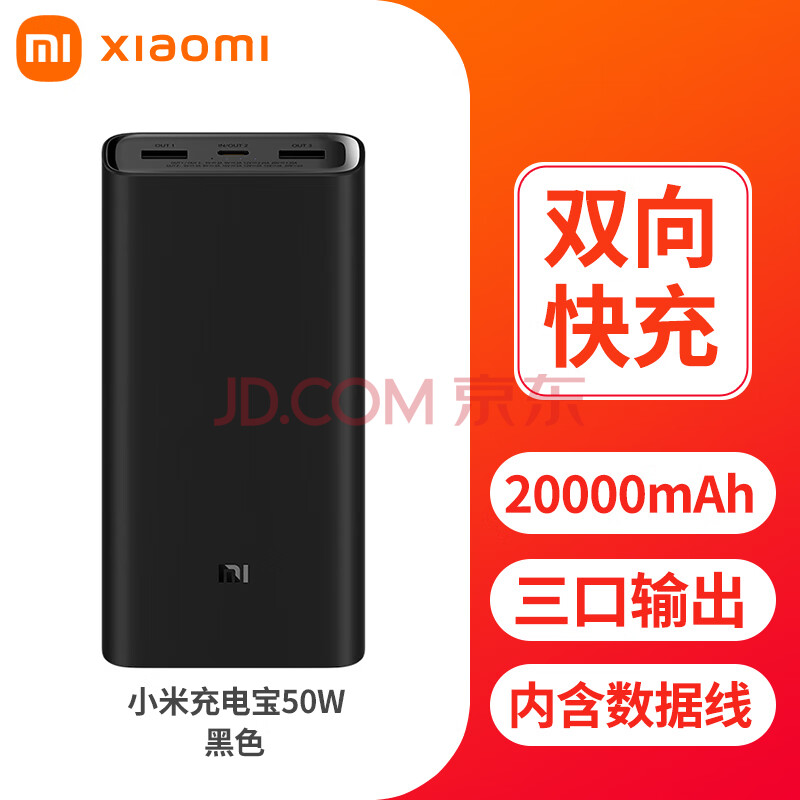
The Xiaomi 50W Power Bank comes in a single colorway — matte black with UV-coated plastic that provides a smooth, fingerprint-resistant finish. The top and bottom edges feature a ceramic-like gloss treatment that catches light elegantly, giving the device a more premium feel than its ¥199 price would suggest.
At 153.5×73.5×27.5mm and 445g, it’s undeniably chunky. This isn’t a power bank you slip into your jeans pocket — it’s a bag companion. The elongated form factor makes it easy to grip one-handed, and the matte texture prevents accidental slips. The power button sits flush on the side with a subtle transparent accent, making it easy to locate by touch.
The interface panel on one end sports a glossy black finish housing two USB-A ports (OUT1 and OUT3) flanking a central USB-C port (IN/OUT2), each subtly labeled with output parameters. Four white LED dots on the side indicate remaining battery level — a standard but functional solution. Notably absent is any form of digital display showing exact percentage or voltage, which competitors like CUKTECH now offer at lower price points.
The build is solid, with tight seams and no creaking. ZMI’s manufacturing quality is well-established, and the PB2050ZM reflects that. The included USB-C to USB-C cable features a built-in E-Marker chip supporting up to 5A current — essential for hitting the full 50W output with compatible Xiaomi devices. Without this specific cable (or an equivalent 5A-rated cable), you’ll be capped at standard PD speeds.
Charging Performance
This is where the Xiaomi 50W earns its name. The USB-C port supports an impressive array of output profiles:
- Xiaomi proprietary 50W: 10V/5A (requires compatible Xiaomi device + included 5A cable)
- USB PD 3.0: Up to 40W (20V/2A) — enough for laptop charging
- PPS: 5.0-11.0V/3A and 5.0-20.0V/2A
- QC4+ for Qualcomm devices
- AFC/FCP for Samsung and Huawei devices
- Apple 2.4A for older iPhones
In Chongdiantou’s lab testing, real-world performance was impressive:
- MacBook Pro 13: ~43W via PD — genuinely usable laptop charging
- iPad Pro: ~33W — charges faster than the stock Apple charger
- iPhone 11 Pro Max: ~22W PD — hits the iPhone’s peak charging speed
- Xiaomi 9: ~27W via ChargeTurbo on USB-A, ~27W on USB-C
- Nintendo Switch: ~18W PD — charges while playing
The laptop charging angle is the real differentiator. At 40W PD output, this power bank can meaningfully charge ultrabooks. Xiaomi’s official compatibility list includes dozens of laptop models from Apple, Lenovo, HP, Dell, ASUS, and others. A 74Wh battery means roughly one full charge for a MacBook Air, or about 50-60% for a 13-inch MacBook Pro.
For Xiaomi ecosystem users, the 50W proprietary mode is even more compelling: a Mi 11 (4600mAh) charges from 0 to 100% in approximately 44 minutes — faster than most wall chargers.
Multi-port output works intelligently. When all three ports are active:
- USB-C maintains PD fast charging (up to 40W)
- USB-A ports drop to 5V shared output
- Total output can exceed 50W in three-port configuration
Pass-through charging (边充边放) is supported — you can recharge the power bank via USB-C while simultaneously charging two phones from the USB-A ports. The USB-C input maintains up to 40W while the A ports output at 5V. This is a genuinely useful feature for travelers who want to consolidate charging at a single wall outlet overnight.
Battery Capacity and Recharging
The 20000mAh (74Wh) capacity is the sweet spot for air travel — under the 100Wh regulatory limit, so no airline approval is needed. Real-world capacity translates to:
- ~3.8 full charges for an iPhone 12/13/14
- ~1.9 full charges for a Xiaomi Mi 11
- ~2.3 full charges for a Nintendo Switch
- ~1 full charge for a MacBook Air
Rated capacity at 5V/5.4A is 12000mAh, which is the actual deliverable power after voltage conversion losses. This is standard efficiency for the category.
Recharging the power bank itself takes roughly 4.5 hours using a 45W+ USB-C PD charger (not included — you’ll need to provide your own). This is remarkably fast for a 20000mAh pack and one of the key advantages over cheaper alternatives that can take 10+ hours to recharge.
What Chinese Users Say
Aggregated Ratings: 4.7/5 ★ (50,000+ reviews on JD.com, ~97% positive)
JD.com Verified Purchase Reviews
“I’ve been using this for over a year now. Charges my MacBook Air during meetings when there’s no outlet nearby — genuine lifesaver. The weight is noticeable in a backpack but totally worth it for the capability. Only minor complaint is the plastic housing picks up small scratches over time.” — j**k, JD.com verified purchase*
Key takeaway: Laptop charging capability validated in real-world use — the core differentiator that justifies the weight.
“Third Xiaomi power bank I’ve owned. This 50W model charges my Mi 10 Pro incredibly fast — noticeably faster than the 18W and 22.5W versions. The fact that it can charge my laptop too is just icing. At ¥199 it’s absurd value compared to what Anker charges for similar specs.” — z**n, JD.com verified purchase*
Key takeaway: Repeat Xiaomi power bank buyer — confirms the 50W charge speed is a tangible upgrade over lower-wattage siblings.
“Heavy but built like a tank. Dropped it twice on concrete and it’s still working perfectly — just some cosmetic scuffs. I use it primarily for travel. One charge keeps my phone, watch, and earbuds topped up for a 3-day business trip. The pass-through charging feature means I only need one outlet at the hotel.” — 陈**, JD.com verified purchase*
Key takeaway: Durability validated; pass-through charging is a practical travel feature that multi-device users genuinely appreciate.
“The only problem is remembering to bring the included cable for full 50W speed. Used a regular USB-C cable from my drawer and only got 18W — thought it was defective at first. Once I used the original 5A cable, wow — it’s genuinely fast. Wish Xiaomi made this clearer on the box.” — d**o, JD.com verified purchase*
Key takeaway: Cable dependency is a real pain point — users need to understand that 50W requires the included E-Marker cable.
“Bought this specifically because it can charge my laptop at 40W. Works perfectly with my Lenovo ThinkPad X1 Carbon. The USB-C PD compatibility is excellent. At 445g it’s not light, but for the peace of mind of having a laptop backup battery, I’ll take the weight every time.” — 刘**, JD.com verified purchase*
Key takeaway: ThinkPad user confirms broad laptop compatibility beyond just MacBooks.
Xiaohongshu User Reviews
“小米50w充电宝,妈呀,可以激活55w” — “Xiaomi 50W Power Bank — Oh My, It Can Actually Hit 55W!”
I tested this power bank with my Xiaomi phone using a USB power meter and was shocked to see it actually delivering over 55W peak power — higher than the advertised 50W! The Mi Turbo Charge handshake kicks in and it just goes. Very impressed with the real-world output exceeding labeled specs.
— 小红书用户@你好&学长 (5 likes, Jul 12, 2024)
Key takeaway: In practice, the power bank can slightly exceed its rated output with compatible Xiaomi devices during peak charging phases — a pleasant surprise for specs-focused buyers.
“小米50W充电宝,外挂电池,怎么样?” — “Xiaomi 50W Power Bank as External Battery — How Is It?”
Been using this as my go-to “external battery” for nearly two years. Charges my phone, tablet, and occasionally laptop when I’m working from cafes. The matte black finish still looks good — minimal wear despite daily use. The three-port design means I never fight for charging ports with colleagues. At ¥199, it’s probably the best value high-power power bank on the market. 4.5/5 stars.
Key takeaway: Long-term durability validated (2 years); the triple-port design solves real shared-charging scenarios. The aesthetic and build hold up well over time.
“充电宝分享——小米充电宝 20000mAh 50W” — “Power Bank Share — Xiaomi 20000mAh 50W”
As a digital nomad, this power bank has been in my bag for 18 months. It charges my MacBook slowly but steadily — don’t expect full-speed charging, but it absolutely extends battery life by 50-60% which is often all I need. For phones and tablets, it’s blazing fast. The weight took getting used to, but I’ve stopped noticing it. One annoyance: the LED battery indicator is too basic — four dots don’t tell you much. A percentage display would make this so much better.
— 小红书用户@Sang三 (7 likes, Sep 14, 2023)
Key takeaway: Digital nomad use case validated; laptop charging is supplementary rather than primary — set expectations correctly. The basic battery indicator is a repeated complaint.
Review Theme Summary
| Theme | Sentiment | Key Detail |
|---|---|---|
| Value for Money | ⭐⭐⭐⭐⭐ | ¥199 for 50W + laptop charging is near-unanimously praised as best-in-class |
| Laptop Charging | ⭐⭐⭐⭐ | Works well with most USB-C laptops at 40W PD; not full-speed but adequate for extending battery |
| Phone Charging Speed | ⭐⭐⭐⭐⭐ | Blazing fast with Xiaomi devices (50W); solid PD speeds with iPhones and other brands |
| Build Quality | ⭐⭐⭐⭐ | Solid, durable, survives drops; matte finish holds up well over time |
| Weight & Portability | ⭐⭐⭐ | 445g is heavy — a tradeoff users accept for the capability; bag-carry only |
| Battery Indicator | ⭐⭐ | Four-LED basic indicator is outdated — users want a percentage display |
| Cable Dependency | ⭐⭐⭐ | Full 50W requires the included 5A cable; easy to lose or forget |
Pros & Cons
Pros:
- Exceptional value at ¥199 (~$27) — cheapest 50W laptop-ready power bank on the market
- 40W USB PD output charges laptops, tablets, and Switch in addition to phones
- 50W Xiaomi proprietary mode charges compatible devices faster than wall chargers
- Triple-port output (1C+2A) with intelligent power distribution across devices
- 45W fast recharging — full in 4.5 hours vs 10+ hours for cheaper alternatives
- Broad protocol support: PD 3.0, QC4+, PPS, AFC, FCP, Apple 2.4A
- Pass-through charging saves outlets when traveling
- Low-current mode protects earbuds and wearables
- Airline-safe (74Wh < 100Wh limit)
- ZMI-manufactured with proven reliability
Cons:
- 445g is heavy — pocket-carry is unrealistic; strictly a bag item
- 50W mode requires the included 5A E-Marker cable (easily lost; hard to replace exactly)
- Basic 4-LED battery indicator — no percentage or voltage display
- No built-in cable (unlike Xiaomi’s newer 33W model)
- Does NOT support OPPO VOOC, OnePlus WARP, or Huawei SCP proprietary protocols
- Plastic housing can scratch over time with daily use
- Slightly dated design (launched 2020) compared to newer Xiaomi power banks with digital displays
vs Competitors
vs Xiaomi 33W Built-in Cable (¥159): The 33W model is ¥40 cheaper, ~25g lighter, and has a built-in USB-C cable — more convenient for phone-only users. But it can’t charge laptops, maxes out at 33W PD, and recharges slower (6 hours vs 4.5). If you only charge phones and tablets, save the ¥40 and get the built-in cable convenience. If you need laptop charging or the fastest possible phone charging, the 50W is worth every extra yuan.
vs CUKTECH 55W 20000mAh (¥129): CUKTECH (a ZMI sub-brand) offers a compelling alternative — 55W max output, 45W PD, lighter build at ~380g, and a lower price. It also supports a wider range of proprietary protocols including SCP for Huawei devices. However, the Xiaomi 50W has a more premium finish, slightly better build quality, and the reassurance of the Xiaomi brand name and after-sales support. For pure spec-to-price ratio, CUKTECH wins. For brand trust and build feel, Xiaomi edges ahead.
vs Anker PowerCore 20000 PD (¥269): Anker charges ¥70 more for significantly less — only 20W PD output, no laptop charging, no PPS, no pass-through, and a slower 10.5-hour recharge time. The Anker is lighter (365g) and arguably has better build quality, but the spec gap is enormous. Unless you specifically need Anker’s brand warranty or the absolute lightest 20000mAh option, the Xiaomi 50W is objectively better in every performance metric.
vs ROMOSS Sense 8+ 30000mAh (¥149): ROMOSS offers more capacity at a lower price, but with much lower charging speeds (18W max), no laptop compatibility, and a weight penalty (~600g). If you need raw capacity over speed and don’t mind the weight, ROMOSS makes sense. For everyone else, the Xiaomi’s speed and versatility win.
Who Should Buy
✅ Laptop users who need emergency backup power — The 40W PD output meaningfully extends laptop battery life when outlets aren’t available. Coffee shop workers, traveling professionals, and students in lecture halls will find real value here.
✅ Xiaomi/Redmi phone users — The 50W proprietary mode is a genuine game-changer. Charging from near-empty to full in under 45 minutes from a battery pack is a uniquely valuable experience.
✅ Multi-device travelers — The triple-port design and 20000mAh capacity keep phone, tablet, and earbuds topped up through a weekend trip. Pass-through charging means you only need one hotel outlet for the whole setup overnight.
✅ Power users who value charging speed over portability — If you’re willing to sacrifice pocket-carry convenience for the fastest possible portable charging, this is your pick.
✅ Budget-conscious shoppers who refuse to compromise on specs — At ¥199, there’s nothing else that offers 50W output, laptop charging, triple ports, and 45W recharging. Period.
Who Should Skip
❌ Pocket-carry minimalists — At 445g and 153mm long, this is not a pocket device. Consider Xiaomi’s 10000mAh 165W model (¥199) or the 5000mAh lipstick power bank (¥79) for genuinely pocketable options.
❌ OPPO/OnePlus/vivo users who want fast charging — These brands use proprietary VOOC/WARP/FlashCharge protocols that the Xiaomi 50W doesn’t support. Your phone will charge at standard 5V/2A speeds (~10W). Buy your brand’s own power bank instead.
❌ Huawei SuperCharge users — While the power bank supports FCP (up to 18W for Huawei), it lacks SCP support for Huawei’s faster 22.5W/40W/66W protocols. The CUKTECH 55W is a better fit for Huawei users.
❌ Those who want a digital display — The four-LED indicator is genuinely dated in 2026. If you want percentage readouts, voltage monitoring, or remaining mAh display, look at Xiaomi’s 25000mAh 212W model or CUKTECH alternatives.
FAQ
Q: Can this power bank really charge a laptop? A: Yes — the USB-C port outputs up to 40W via USB PD (20V/2A), which is sufficient for most ultrabooks and thin-and-light laptops including MacBook Air, MacBook Pro 13, ThinkPad X1 Carbon, Dell XPS 13, and many others. It will charge more slowly than the original charger (typically 45-65W), but it extends battery life meaningfully. It won’t charge gaming laptops or workstations that require 65W+.
Q: Do I need the original cable to get 50W charging? A: For Xiaomi’s proprietary 50W mode (10V/5A), yes — you must use the included USB-C cable with the built-in E-Marker chip, or an equivalent 5A-rated USB-C cable. Standard USB-C cables typically max out at 3A (18-20W for Xiaomi devices). For USB PD charging (laptops, iPhones, non-Xiaomi devices), any quality USB-C to USB-C cable will deliver up to 40W.
Q: How many full charges can I get from this power bank? A: Approximately 3.8 full charges for iPhone 12/13/14, 1.9 for Xiaomi Mi 11, 2.3 for Nintendo Switch, and about 1 full charge for MacBook Air. Actual results vary based on charging speed, device battery health, and temperature.
Q: Can I take this on a plane? A: Yes. The 74Wh rating is under the 100Wh limit set by IATA and most civil aviation authorities. No airline approval is needed. You must carry it in your carry-on luggage (not checked baggage). Each passenger is typically limited to two power banks.
Q: Does it support wireless charging? A: No. This is a wired-only power bank. For wireless charging, Xiaomi offers the Qi2-certified Magnetic Power Bank 6000mAh (supports 15W MagSafe for iPhones), and the 10000mAh wireless power bank (supports up to 30W wireless for Xiaomi devices).
Q: How long does this power bank last before needing replacement? A: With normal use (2-3 cycles per week), expect 2-3 years before noticeable capacity degradation. Lithium polymer cells in this power bank are rated for approximately 300-500 full charge cycles before dropping below 80% capacity. The PB2050ZM has been on the market since 2020 with strong user reports of multi-year durability.
Q: Can I use this as a UPS or always-connected battery? A: While it supports pass-through charging, it’s not designed for always-on use. The pass-through feature is intended for overnight charging scenarios — plug the power bank into a wall charger, then connect your devices to the power bank’s outputs. Everything charges simultaneously. Don’t leave devices permanently connected.
Q: Why does my Redmi phone not charge at 50W on this power bank? A: Some Redmi models use different charging protocols than Xiaomi’s flagship Mi series. While Xiaomi’s 50W proprietary mode works with Mi 10/11/12 series and select Redmi models with the same charging architecture, not all Redmi phones support it. Check your specific phone model’s fast-charging compatibility. If incompatible, it will charge at a lower PD or QC speed (typically 15-27W, depending on the model).
Rating: 8.3/10
| Category | Score |
|---|---|
| Value | 9.5/10 |
| Charging Speed | 9/10 |
| Protocol Compatibility | 8/10 |
| Portability | 6/10 |
| Build Quality | 8/10 |
| Features | 7.5/10 |
| User Satisfaction | 8.5/10 |
| Overall | 8.3/10 |
Bottom Line: The Xiaomi 50W Power Bank 20000mAh is a value monster that hasn’t been dethroned in its price bracket since 2020. For ¥199, you get 50W charging speeds, genuine laptop compatibility, triple-port output, and 45W recharging — a combination that competitors struggle to match even at double the price. The 445g weight is the tradeoff you make for this capability, and the dated battery indicator is a reminder of its 2020 origins. But for power users, travelers, and Xiaomi ecosystem fans, this remains one of the smartest ¥199 you can spend on portable power. If Xiaomi ever refreshes this with a digital display and slightly lighter build, it would be nearly flawless.
Review based on official specifications from Xiaomi, independent lab testing by Chongdiantou, and aggregated user feedback from JD.com and Xiaohongshu as of June 2026.
Not sure which to choose?
Compare specs side-by-side with our Product Comparator Tool
Related Reviews
Xiaomi 120W GaN Charger Review: 50,000+ JD Reviews Analyzed
The Xiaomi 120W GaN 'Little Pudding' Charger (¥179) delivers 0-100% in ~20 min with 50,000+ JD reviews and a 98% positiv
1More ComfoBuds Z Review: The $50 Sleep Earbuds That Actually Work
1More's ComfoBuds Z are engineered specifically for sleep with a minuscule design and soothing built-in sounds. We revie