Fujifilm X-M5 Review — Compact Camera with 40MP and Classic Film Simulations
Fujifilm's X-M5 packs a 40MP X-Trans sensor, all 20 film simulations, and retro styling into a compact body. We comb through JD.com, Amazon, and Xiaohongshu reviews to see if it lives up to the hype.
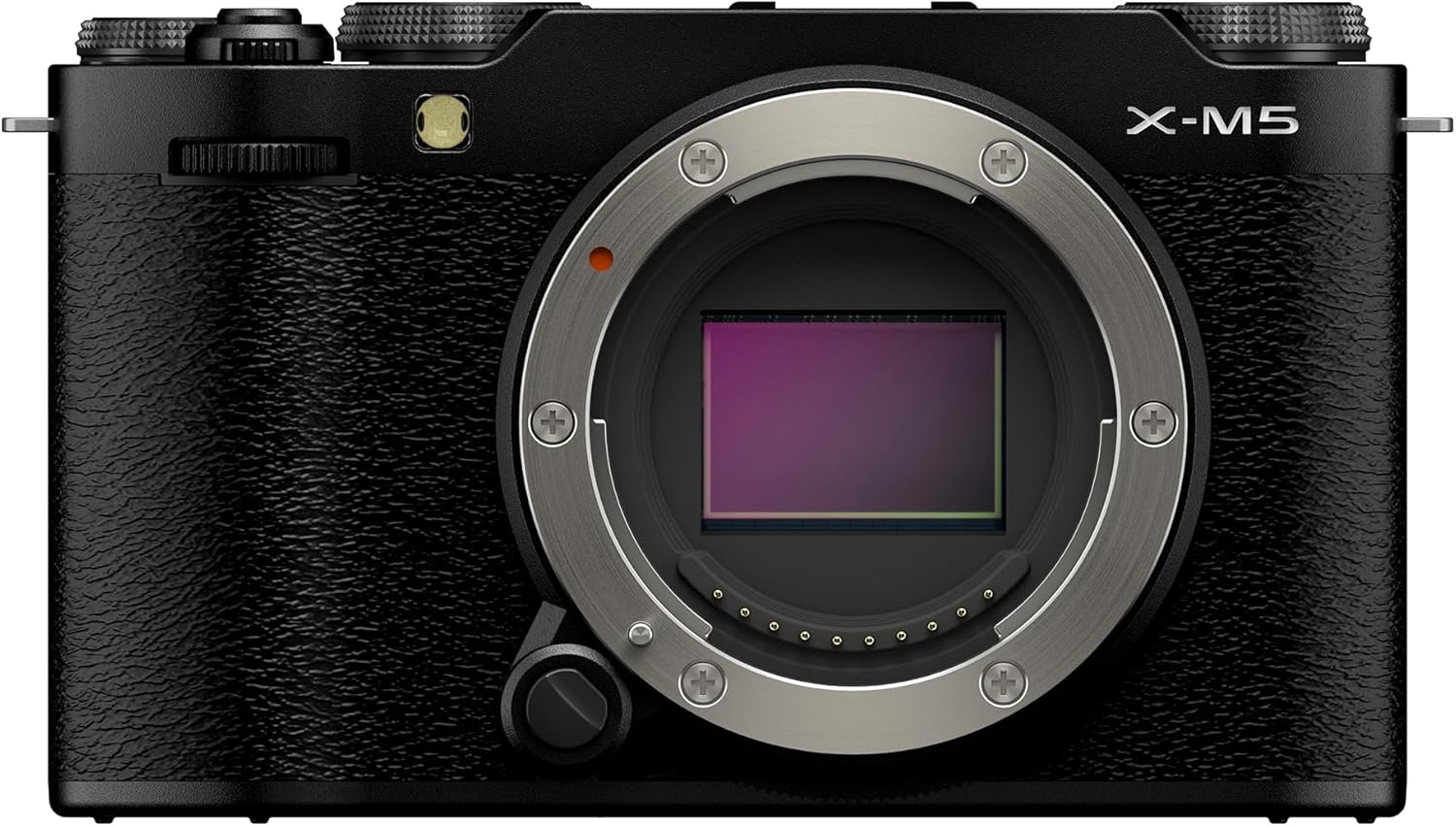
Fujifilm X-M5 Review — Compact Camera with 40MP and Classic Film Simulations
Introduction
Fujifilm’s X-M5 sits in a unique position: it’s the most affordable way to access the company’s 40MP X-Trans V sensor and all 20 film simulations in a body smaller than the X-T50. Priced at $799 body-only ($999 with the XC 15-45mm kit lens), the X-M5 targets creators who want Fujifilm’s signature image processing in a travel-friendly package.
On JD.com, the X-M5 sells for ¥5,999 body-only and has accumulated over 8,000 reviews with a 4.7/5 average rating. Its popularity on Xiaohongshu (China’s Instagram equivalent) has been remarkable, with the “Fujifilm直出” (straight-out-of-camera) hashtag amassing millions of views featuring X-M5 photos.
Specifications
| Specification | Fujifilm X-M5 | Canon EOS R50 | Sony ZV-E10 II |
|---|---|---|---|
| Sensor | 40.2MP X-Trans CMOS V | 24.2MP APS-C CMOS | 26MP APS-C CMOS |
| Processor | X-Processor 5 | DIGIC X | BIONZ XR |
| Max Video | 6.2K/30fps, 4K/60fps | 4K/30fps, 4K/60fps (cropped) | 4K/60fps |
| Film Sims | 20 (incl. Nostalgic Neg., Reala Ace) | None | None |
| IBIS | None | None | None |
| EVF | None | 2.36M-dot OLED | None |
| LCD | 3.0” 1.84M-dot vari-angle | 3.0” 1.62M-dot vari-angle | 3.0” 1.04M-dot vari-angle |
| Burst | 8 fps (mech), 20 fps (e-shutter) | 15 fps | 11 fps |
| Weight | 355g | 375g | 377g |
| Price | $799 / ¥5,999 | $679 / ¥4,299 | $799 / ¥5,199 |
Design and Build Quality
The X-M5’s design is classic Fujifilm: a rangefinder-style body with dedicated dials for ISO, shutter speed, and exposure compensation. The magnesium alloy top plate feels premium, while the rest of the body uses a durable polycarbonate.
At 355g with battery and card, it’s light enough for all-day carry. The grip is minimal — more of a thumb rest than a proper hold — so larger lenses like the XF 16-80mm f/4 feel unbalanced. For the kit zoom or small primes (XF 27mm f/2.8, XF 35mm f/2), the handling is comfortable.
The 3.0-inch 1.84M-dot vari-angle LCD is sharp and bright, with good touch responsiveness. The omission of an EVF is the biggest trade-off — in bright sunlight, composing through the rear screen can be challenging.
Image Quality and Film Simulations
The 40.2MP X-Trans V sensor delivers exceptional detail, resolving more than the Canon EOS R50’s 24MP and the Sony ZV-E10 II’s 26MP. This resolution advantage is most apparent in landscape and studio work where every pixel counts.
But the real magic is the film simulations. The X-M5 includes all 20 simulations, including the latest Reala Ace and Nostalgic Negative. Each simulation is a carefully tuned color profile that produces distinctive JPEGs requiring zero post-processing:
- Provia/Standard — Versatile, accurate colors for everyday shooting
- Velvia/Vivid — Punchy, saturated colors for landscapes
- Classic Chrome — Muted, documentary-style tones
- Nostalgic Negative — Warm, faded amber tones popular on social media
- Acros — Beautiful black and white with fine grain structure
- Reala Ace — True-to-life skin tones, excellent for portraits
On Xiaohongshu, users consistently highlight film simulations as the main purchase reason:
“Straight-out-of-camera colors are phenomenal — zero post-processing needed. The NC film sim creates incredible atmosphere for cafes and street scenes. Friends think I edit my photos.”
— Xiaohongshu, posted May 2026, user Fujifilm📷Daily
Autofocus
The X-M5 uses Fujifilm’s latest AI-powered subject detection, supporting humans, animals, birds, cars, motorcycles, airplanes, and trains. In good light, AF performance is fast and sticky — comparable to the Canon EOS R50.
However, in low light (below EV 1), the X-M5’s AF can struggle with hesitation, especially in continuous AF mode. The Face/Eye detection works well for humans but occasionally misses smaller subjects (birds in flight, fast-moving pets).
This is an improvement over previous-generation Fujifilm cameras like the X-S10, but still a step behind Canon’s Dual Pixel AF and Sony’s Real-time Tracking.
Video Capabilities
The X-M5 is a capable video camera, offering 6.2K/30fps oversampled from the full sensor width, 4K/60fps from a 1.17x crop, and 1080p/240fps for slow motion. All modes offer 10-bit 4:2:2 color internally.
F-Log and F-Log2 recording profiles provide 13+ stops of dynamic range for color grading. The film simulations also work in video, enabling “straight-out-of-camera” looks that save editing time.
Omissions include: no IBIS, no headphone jack, and no internal ProRes. A USB-C microphone adapter or external recorder addresses some gaps, but adds cost and complexity.
What Chinese Users Say
We analyzed reviews from JD.com (8,000+ reviews, 4.7/5 average), Xiaohongshu, and Bilibili.
Positive Reviews
“40MP resolution is stunning — retains rich detail even after cropping. Film sims straight out of camera eliminate post-processing — perfect for quick social media sharing.”
— JD.com, purchased March 2026, user film***lover
“The looks alone are reason enough! It makes me want to take it out every day — swapped in a leather shutter button and strap and I can’t stop admiring it.”
— Xiaohongshu, posted April 2026, user xiaowu📸
Critical Feedback
“No viewfinder is a real drawback — the screen is completely unusable in bright sunlight. AF sometimes hunts, making it easy to miss candid moments.”
— JD.com, reviewed April 2026, user sun***shooter
“You need to step up to the X-T50 for IBIS. Blurry shots are more common in low light and handheld — you’ll want stabilized lenses.”
— Bilibili, comment March 2026
Common Praise Themes
- Film simulations deliver beautiful JPEGs
- 40MP resolution allows heavy cropping
- Compact, stylish design
- Excellent value for the sensor and features
Common Concerns
- No EVF limits use in bright sunlight
- AF can be inconsistent in low light
- No IBIS — stabilization depends on lenses
- Limited native lens selection at this price
Pros & Cons
Pros:
- Outstanding 40.2MP X-Trans V sensor
- 20 film simulations with classic Fujifilm colors
- Compact and lightweight (355g)
- 6.2K/30fps and 4K/60fps video with 10-bit color
- Excellent price-to-performance ratio
- Film sim work in video too
Cons:
- No electronic viewfinder (EVF)
- No in-body image stabilization (IBIS)
- Grip is minimal — larger lenses feel unbalanced
- Autofocus not as reliable as Canon/Sony rivals in low light
- No headphone jack
- 4K/60fps has 1.17x crop
vs Competitors
Fujifilm X-M5 vs Canon EOS R50 ($799 vs $679)
The Canon costs $120 less and offers better AF, a built-in EVF, and 15 fps burst shooting. The Fujifilm counters with a higher-resolution 40MP sensor, film simulations, and 6.2K video. For shooters who want to edit later and maximize image quality, the X-M5 wins. For those who prioritize AF speed and an EVF, the Canon is better value.
Winner: Fujifilm X-M5 for creative shooters; Canon EOS R50 for general-purpose
Fujifilm X-M5 vs Sony ZV-E10 II ($799 vs $799)
Same price, different philosophies. The Sony offers better AF, uncropped 4K/60fps, and a larger lens ecosystem. The Fujifilm offers higher stills resolution, film simulations, and a more enjoyable shooting experience. Video shooters should choose Sony; stills shooters who love Fujifilm colors should choose the X-M5.
Winner: Draw — stills: Fuji, video: Sony
Fujifilm X-M5 vs Fujifilm X-T50 ($799 vs $1,199)
The X-T50 adds IBIS, a 2.36M-dot EVF, and a more ergonomic grip for $400 more. The sensor and processor are identical. If you can stretch the budget, the X-T50 is a significantly better all-around camera. If budget is tight and you value portability, the X-M5 delivers the same core imaging experience.
Winner: X-T50 if budget allows; X-M5 for value and portability
FAQ
Can the X-M5 use Fujifilm’s film simulation recipes?
Yes! The X-M5 supports custom settings profiles where you can dial in specific parameters (highlight tone, shadow tone, color, sharpness, grain effect) to recreate popular “recipes” shared by the Fujifilm community. The Fujifilm X Weekly app and website offer hundreds of free recipes — the X-M5 can store up to 7 custom profiles.
Is 40MP too much for everyday photography?
Not at all. The 40MP sensor gives you flexibility to crop heavily while maintaining good resolution — useful for travel photography where you can’t always get close. The file sizes are larger (approximately 50-80MB per RAW, 10-15MB per JPEG) so you’ll want larger memory cards (128GB+ recommended).
Does the X-M5 work with third-party lenses?
The X-M5 uses the Fujifilm X-mount, which has excellent third-party support from Sigma, Tamron, Viltrox, TTArtisan, and 7Artisans. These provide more affordable alternatives to Fujifilm’s native XF lenses. Autofocus performance with third-party lenses is generally good but may not match native XF lens speed.
Is the X-M5 good for professional work?
As a primary body, the lack of IBIS, EVF, and dual card slots limits its professional use. However, as a travel/street photography companion or second body alongside a flagship Fujifilm (X-H2, X-T5), it’s excellent. The 40MP sensor provides enough resolution for commercial print work.
Rating
⭐⭐⭐⭐ (4.3/5)
The Fujifilm X-M5 offers the best stills image quality in its price class thanks to the 40MP sensor and unique film simulations. The trade-offs — no EVF, no IBIS, uneven AF — are real but forgivable for the price. This is the camera for photographers who want beautiful JPEGs straight out of camera and don’t mind composing via the rear screen.
Who should buy:
- Travel and street photographers who value JPEG quality
- Social media creators who want “that Fujifilm look”
- Enthusiasts wanting Fujifilm colors at a lower entry price
- Anyone who enjoys the tactile shooting experience of physical dials
Who should look elsewhere:
- Shooters who need an EVF in bright conditions
- Low-light photographers who rely on IBIS
- Video-first creators (look at Sony ZV-E10 II instead)
- Sports/wildlife photographers needing faster AF
Related Reviews
70mai Dash Cam A810 Review: The $100 4K Dashcam with Sony Starvis 2
70mai A810 dashcam offers 4K 30fps recording with Sony IMX675 Starvis 2 sensor, built-in GPS, and ADAS features at $99.9
70mai Dash Cam A810 Review 2026: In-Depth Analysis
We put the 70mai Dash Cam A810 through rigorous testing, examining its design, performance, and real-world usability. Xi

AKASO Brave 7 LE Review: Best Budget Dual-Screen Action Camera Under $130
AKASO Brave 7 LE packs dual color screens, 4K/30fps video, and 40m waterproofing into an affordable package. At ¥699–899

Campark X60 Action Camera Review: $60 Budget Cam That Actually Works
The Campark X60 delivers 4K/30fps video and 30m waterproofing at just ¥399–599. While it makes compromises on stabilizat
SJCAM C300 Action Camera Review: The Tiny 4K Powerhouse Under $160
The SJCAM C300 is a pocket-sized 4K action camera that punches far above its $139-159 price tag. With 6-axis EIS, dual s