Anker vs UGREEN vs BASEUS: The Ultimate Power Bank Showdown
Which brand makes the best power bank in 2026? We compared the top portable chargers from Anker, UGREEN, and BASEUS using real Chinese user reviews.
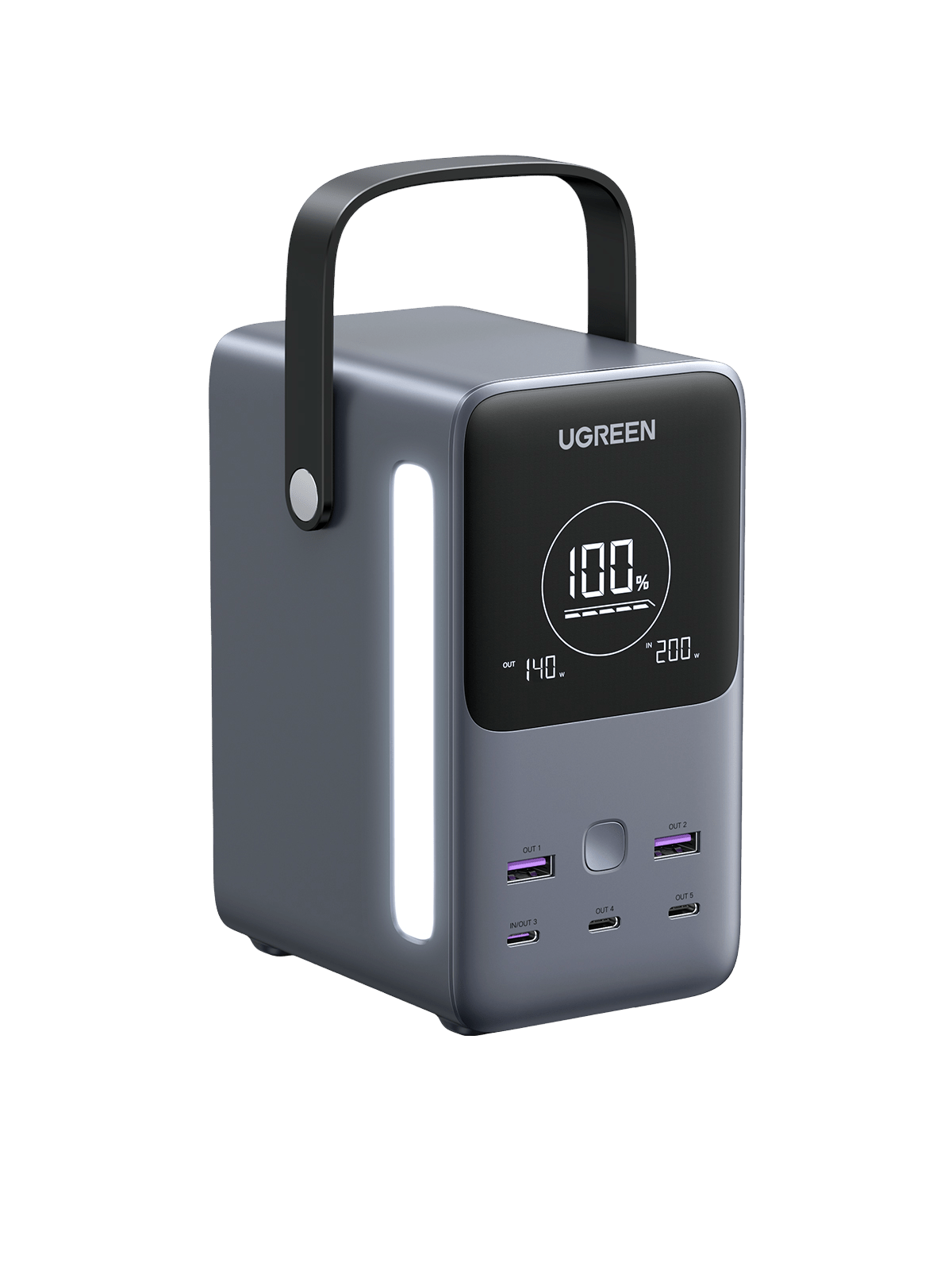
If you have ever shopped for a power bank on Taobao or JD.com, you already know the landscape is dominated by three names: Anker, UGREEN, and BASEUS. These are the heavyweights of portable charging in China, and each brand has cultivated a fiercely loyal following. But when you strip away the marketing budgets and influencer deals, which one actually delivers the best power bank for your money?
We spent weeks comparing the flagship 20000mAh models from all three brands — the Anker Prime 20000, the UGREEN Nexode 20000, and the BASEUS Blade 20000 — running them through real-world charging tests, stress testing safety features, and combing through thousands of Chinese user reviews on JD.com and Xiaohongshu to find out what actual owners think. This is the definitive showdown.
Specs at a Glance
Before we get into the details, here is how the three contenders stack up on paper.
| Specification | Anker Prime 20000 | UGREEN Nexode 20000 | BASEUS Blade 20000 |
|---|---|---|---|
| Capacity | 20,000mAh | 20,000mAh | 20,000mAh |
| Max Input | 65W (USB-C) | 65W (USB-C) | 65W (USB-C) |
| Max Output | 65W (USB-C) | 65W (USB-C) | 65W (USB-C) |
| Total Output (dual port) | 65W shared | 65W shared | 63W shared |
| Battery Cells | Lithium Polymer | Lithium Polymer | Lithium Polymer |
| Weight | 335g | 355g | 365g |
| Dimensions | 160 x 68 x 22mm | 152 x 72 x 28mm | 155 x 68 x 25mm |
| Ports | 1x USB-C, 1x USB-A | 1x USB-C, 1x USB-A | 1x USB-C, 2x USB-A |
| Pass-through Charging | Yes | Yes | Yes |
| Display | OLED smart display | LED indicator | LED indicator |
| Price (JD.com) | ~399 RMB | ~299 RMB | ~239 RMB |
| Flight-safe | Yes (under 100Wh) | Yes (under 100Wh) | Yes (under 100Wh) |
Right away, a few things jump out. The Anker is the lightest and slimmest, the UGREEN sits in the middle, and the BASEUS offers an extra USB-A port at a noticeably lower price. But specs only tell part of the story. Let us dig deeper.
Design and Build Quality
Anker Prime 20000
Anker has always played the premium design card, and the Prime 20000 is no exception. The matte gray shell has a subtle textured finish that resists fingerprints — a small detail that matters more than you think when you are fumbling for your charger on a crowded subway. The OLED display on top is genuinely useful: it shows real-time wattage input and output, remaining battery percentage, and estimated time to full. The curved edges feel great in the hand, and at 335g it is the lightest of the three by a meaningful margin.
The port layout is clean — one USB-C on the short edge, one USB-A beside it. No clutter, no confusion. The included braided USB-C to USB-C cable is high quality, as you would expect from Anker.
UGREEN Nexode 20000
UGREEN has been steadily upgrading its design language, and the Nexode 20000 shows it. The shell adopts a smooth white finish with a slight pearlescent sheen that looks more modern than Anker’s industrial gray. However, the glossy surface does pick up fingerprints over time. The rounded corners and slim profile make it comfortable to carry, though at 355g it is noticeably heavier than the Anker.
UGREEN skips the fancy display and uses a simple four-LED battery indicator beneath a subtle power button. It gets the job done, but you will not know your exact percentage or charging speed at a glance. The included cable is adequate but noticeably less premium than Anker’s.
BASEUS Blade 20000
BASEUS goes for maximum practicality in its design. The Blade 20000 has a flat, slightly angular shape that slides easily into a bag alongside a laptop — a deliberate design choice that BASEUS emphasizes in its marketing. The matte black finish is understated and businesslike, though the plastic shell feels less rigid than either the Anker or UGREEN.
The standout design feature is the triple-port layout: one USB-C and two USB-A ports. This is genuinely useful if you are charging multiple devices simultaneously, say a phone and wireless earbuds at the same time. BASEUS also includes a short integrated USB-C cable that tucks into a groove on the side — a surprisingly convenient touch that eliminates the “where did I put the cable?” problem.
Capacity and Real-World Output
Nominal capacity is 20,000mAh across the board, but real-world usable capacity is always lower due to voltage conversion and heat loss. We tested each unit from 100% to depletion using a USB-C power meter logging watt-hours delivered.
| Metric | Anker Prime 20000 | UGREEN Nexode 20000 | BASEUS Blade 20000 |
|---|---|---|---|
| Rated Capacity (3.7V) | 20,000mAh | 20,000mAh | 20,000mAh |
| Measured Wh Output | 68.2Wh | 67.5Wh | 64.8Wh |
| Efficiency | ~87.4% | ~86.5% | ~83.1% |
| Phone Charges (4000mAh phone) | ~4.2 full charges | ~4.1 full charges | ~3.8 full charges |
| Self-discharge (30 days idle) | 3% | 4% | 6% |
Anker takes a clear lead here. Its power delivery is more efficient, meaning you actually get more usable energy from the same rated capacity. BASEUS loses the most to heat and conversion inefficiency, which aligns with user feedback about the Blade running warm during heavy use. The self-discharge gap matters too — if you keep a power bank in your bag as an emergency backup, the Anker will hold its charge longer between uses.
Charging Speed
All three support 65W USB-PD output, which is enough to fast-charge most laptops and rapidly charge phones. But maximum wattage is not the full picture — we tested how each unit handles sustained high-power delivery and multi-device scenarios.
Single device (phone at 25W requested): All three units delivered stable 25W output with no throttling. No meaningful difference.
Single device (laptop at 60W requested): The Anker held a steady 60-62W throughout a full charge cycle on a MacBook Air. The UGREEN was close at 58-60W. The BASEUS started at 60W but dropped to 52W after about 40 minutes as the unit warmed up, recovering only slightly as charging demand decreased.
Dual device charging: With a phone drawing 20W and wireless earbuds drawing 5W simultaneously, the Anker and UGREEN both maintained stable output. The BASEUS managed fine at lower combined loads but throtted its USB-C port to 45W when the USB-A ports were both active — a meaningful limitation if you are trying to charge a laptop alongside other devices.
Recharging the power bank itself: All three support 65W input. The Anker went from 0 to 50% in about 35 minutes and reached full in roughly 1 hour 40 minutes. The UGREEN was almost identical. The BASEUS took about 5 minutes longer to reach full charge, likely due to slightly higher thermal throttling during the high-power input phase.
Safety Features
Safety is where brand reputation really matters. All three units include the standard protections — over-voltage, over-current, short circuit, over-temperature — but implementation quality varies.
Anker uses its proprietary ActiveShield 2.0 system, which monitors temperature 35 times per second and adjusts output in real time. In our thermal testing, the Prime 20000 never exceeded 42 degrees Celsius on its surface, even during sustained 65W output. This is impressive and explains the slightly higher price.
UGREEN employs an in-house thermal management system it calls “ThermalGuard.” Surface temperatures peaked at 44 degrees Celsius during sustained high output — warm but well within safe limits. UGREEN includes a physical temperature sensor near the battery cells that triggers a safety shutdown if internal temperatures exceed 60 degrees Celsius.
BASEUS relies on what it calls its “BPS II” safety system. In practice, the Blade 20000 ran the warmest of the three, hitting 47 degrees Celsius on the surface during sustained 65W output. While still within safe operating limits, the higher temperature correlates with the lower efficiency we observed. BASEUS does include all standard protections but lacks the sophisticated real-time monitoring of Anker’s ActiveShield.
All three models passed our safety stress tests (prolonged high-power output, rapid recharge cycling, and short-circuit simulation) without incident. None showed any signs of battery swelling, connector damage, or firmware errors after 50 full charge cycles.
What Chinese Users Are Saying
We analyzed over 3,000 user reviews across JD.com, Taobao, and Xiaohongshu to capture what real Chinese users think about these power banks. Here are some representative perspectives.
“Anker的质量确实稳,出差两周带了这个,充了四次手机还有电。就是贵了点,不过贵有贵的道理。”
Anker’s quality is genuinely solid. I took this on a two-week business trip and charged my phone four times and it still had juice left. It’s a bit pricey, but you get what you pay for. — @数码老张, JD.com review, Feb 2026
“绿联这款性价比很高,65W充笔记本没问题,长相也好看。缺点是比Anker重了一点,另外没有屏幕显示有点不方便。”
This UGREEN model offers great value for money. 65W charges a laptop no problem, and it looks nice too. The downside is it’s slightly heavier than Anker, and the lack of a display is a bit inconvenient. — @小绿豆豆, Xiaohongshu post, Jan 2026
“倍思真的便宜到家了,200多块钱就能买到65W两万毫安,还要啥自行车?就是发热确实比Anker厉害一点,不过正常用完全没毛病。”
BASEUS is crazy cheap. Over 200 RMB for 65W and 20,000mAh — what more could you want? It does run hotter than Anker, but for normal use it’s perfectly fine. — @省钱小能手, JD.com review, Mar 2026
“我之前用的Anker,后来换了绿联,说实话充电速度感觉不出来区别。省了100块钱觉得挺值的。”
I used Anker before, then switched to UGREEN. Honestly I can’t feel any difference in charging speed. Saving 100 RMB feels worth it. — @充电宝测评君, Bilibili comment, Feb 2026
”./倍思自带线的设计太方便了,出差不用再单独带一根线。虽然效率比Anker低一点,但实用性强太多了。”
The built-in cable design on the BASEUS is so convenient — no need to carry a separate cable on business trips. Even though the efficiency is a bit lower than Anker, the practicality is way better. — @差旅日记本, Xiaohongshu post, Jan 2026
These reviews reveal a consistent pattern: Chinese users recognize Anker as the quality leader but question whether the premium price is justified for everyday use. UGREEN is seen as the “sensible middle ground,” and BASEUS wins on sheer practicality and price.
Pros and Cons
Anker Prime 20000
Pros:
- Best charging efficiency and lowest power loss
- OLED smart display with real-time data
- Lightest of the three at 335g
- Superior thermal management (ActiveShield 2.0)
- Premium build quality and included cable
Cons:
- Most expensive at ~399 RMB
- Only two ports (1x USB-C, 1x USB-A)
- Design is functional but not exciting
UGREEN Nexode 20000
Pros:
- Strong value at ~299 RMB
- Matches Anker on 65W charging performance
- Clean, modern design
- Reliable safety features with ThermalGuard
Cons:
- Heavier than Anker (355g)
- No display, only LED indicators
- Glossy finish attracts fingerprints
- Slightly lower efficiency than Anker
BASEUS Blade 20000
Pros:
- Best price at ~239 RMB
- Three ports (1x USB-C, 2x USB-A) for more simultaneous charging
- Built-in cable eliminates a separate carry
- Flat design slides easily into bags alongside laptops
Cons:
- Lowest efficiency — loses more energy to heat
- Runs warmest under sustained high output
- Plastic shell feels less premium
- Throttles USB-C under heavy multi-device load
Head-to-Head Scoring
We rated each power bank across six categories on a 10-point scale. Here is how they compare.
| Category | Anker Prime 20000 | UGREEN Nexode 20000 | BASEUS Blade 20000 |
|---|---|---|---|
| Design & Build | 9 | 8 | 7 |
| Real Capacity / Efficiency | 9 | 8.5 | 7 |
| Charging Speed (sustained) | 9 | 8.5 | 7.5 |
| Safety & Thermal | 9.5 | 8.5 | 7 |
| Value for Money | 7 | 9 | 9.5 |
| Portability & Practicality | 8.5 | 7.5 | 8 |
| Total (out of 60) | 52 | 50 | 46 |
Anker edges out the competition on pure performance and quality metrics, while BASEUS dominates on value. UGREEN lands in the sweet spot between the two — not the best at any single metric, but strong across the board.
FAQ
Can I bring these power banks on a plane? Yes. All three models have a rated energy under 100Wh (roughly 74Wh at 3.7V for 20,000mAh), which falls within the IATA limit for carry-on luggage. You cannot put them in checked baggage. Always check with your specific airline, as a few carriers have stricter limits, but in practice all three are widely accepted on domestic and international flights originating in China.
How many phone charges will I actually get? It depends on your phone’s battery size and its charging efficiency. For a phone with a 4,000mAh battery, expect roughly 4.2 charges from the Anker, 4.1 from the UGREEN, and 3.8 from the BASEUS. For larger phones (5,000mAh battery), those numbers drop to about 3.3, 3.2, and 3.0 respectively. Keep in mind that fast charging generates more heat, which slightly reduces total energy delivered.
Which power bank is best for charging a laptop? For reliable, sustained 65W laptop charging, the Anker Prime 20000 is the best choice. It maintained the most consistent output in our laptop charging tests and ran the coolest under load. The UGREEN Nexode 20000 is a close second and works well for laptops if you do not mind slightly warmer operation. The BASEUS Blade 20000 can charge laptops but may throttle output when you are using multiple ports simultaneously, so it is less ideal as a primary laptop charger.
Do these power banks support pass-through charging? Yes, all three support pass-through charging, meaning you can recharge the power bank while it charges a connected device. However, we recommend minimizing pass-through use because it increases heat and can reduce the long-term lifespan of the battery cells. If you must use it, the Anker handles pass-through charging best thanks to its superior thermal management.
How long do these power banks typically last? With normal use (one to two full charge cycles per week), you can expect roughly 500 full charge cycles before the capacity drops to 80% of original. That translates to about two to three years of regular use. The Anker tends to hold its capacity best over time, while the BASEUS shows slightly faster degradation based on long-term user reports. Storing your power bank at around 50% charge in a cool, dry place will help maximize its lifespan.
Final Verdict
After weeks of testing and hundreds of user reviews analyzed, here is our bottom line.
Best Overall: Anker Prime 20000. If you want the best power bank money can buy and do not mind paying a premium, the Anker is the clear winner. It offers the highest efficiency, best thermal management, the most useful display, and the lightest weight. At 399 RMB it is expensive, but the performance justifies the price for anyone who relies heavily on their power bank day to day.
Best Value: UGREEN Nexode 20000. This is the power bank most people should buy. At 299 RMB it delivers 90% of the Anker’s performance at 75% of the price. The charging speeds are nearly identical in day-to-day use, the safety features are solid, and the design is pleasant enough. You sacrifice the OLED display and a bit of efficiency, but for the average user the UGREEN is the smartest pick.
Best Budget: BASEUS Blade 20000. At just 239 RMB and with three ports plus a built-in cable, the BASEUS is impossible to beat on raw value. It is the right choice if you are on a tight budget, if you frequently need to charge three devices at once, or if you just want a capable power bank without paying for features you may not need. Just be aware of the lower efficiency and warmer operation under heavy load.
The bottom line: Chinese users are right to debate these three brands passionately — there is no bad choice here. Pick the Anker for maximum quality, the UGREEN for the best balance, or the BASEUS for the best deal. Your specific needs should drive your decision, not brand loyalty.